Panthéon
Neoclassical mausoleum of the Republic's great, with Foucault's pendulum
- Area Latin Quarter
- Type Church
- Time needed 1h 15m
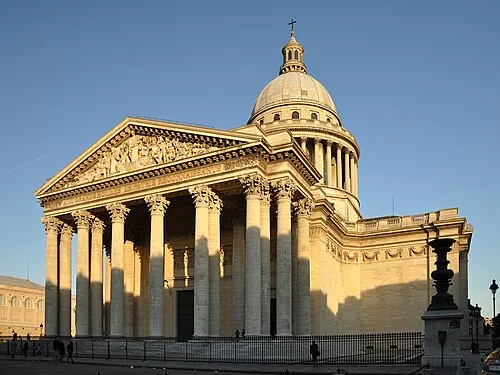
The Panthéon was begun in the 1750s as a church dedicated to Saint Genevieve and converted during the Revolution into a mausoleum for the great men — and, since 1907, women — of the Republic. Voltaire, Rousseau, Victor Hugo, Zola, Marie Curie, Jean Moulin and Josephine Baker are among roughly 80 people buried in the crypt. A working copy of Foucault's pendulum hangs under the dome, where the original was installed in 1851 to demonstrate the rotation of the earth.
Open in the planner →Getting there
There is no Metro at the door. Cardinal Lemoine on line 10 is a five minute walk, and Maubert-Mutualite on the same line is about the same. RER B to Luxembourg is the best connection from the north or from the airports, a five minute walk up the Rue Soufflot with the dome ahead of you. From Chatelet, line 4 to Odeon then a ten minute uphill walk, or RER B to Luxembourg, both around 15 minutes. The building sits at the top of the Montagne Sainte-Genevieve, so every approach is uphill.
What you see
The portico of 22 Corinthian columns and the pediment come first, and the view back down the Rue Soufflot towards the Luxembourg gardens is worth turning round for. Inside, the nave is a vast cold Neoclassical cross with very little furniture, which is the point: it was stripped of its church fittings. The pendulum swings in the centre under the dome on a long wire, knocking over markers as the floor turns beneath it — stand and watch it for a few minutes rather than photographing it. Around the walls, large nineteenth-century mural cycles tell the life of Saint Genevieve and the early history of France, the Puvis de Chavannes panels among them. A stair down leads to the crypt, which is a series of plain barrel-vaulted corridors with name plates and simple tombs; Voltaire and Rousseau face each other near the entrance, Hugo and Zola share a vault, and Marie Curie's grave carries the most flowers. In the warmer months a separate ticketed climb goes up to the colonnade around the outside of the dome, which gives a close view over the Latin Quarter roofs with the Eiffel Tower and Sacré-Coeur on the skyline and is the best thing here on a clear day.
What to pair it with
The Luxembourg gardens are five minutes downhill. Saint-Etienne-du-Mont, with Pascal's and Racine's tombs, is next door. The Cluny medieval museum and the Latin Quarter are a ten minute walk north.
When to go
Mornings on a weekday are quiet; the Panthéon never has Louvre-scale crowds. The dome colonnade usually opens only from spring to autumn and in reasonable weather, so plan the visit for a clear day between April and October if the climb matters. Late afternoon light suits the view from the colonnade. The interior is unheated in feel and genuinely cold in winter, which shortens most visits.
What is hard about it
The nave is austere and some people find it empty rather than solemn — there is less to look at than the exterior promises, and an hour is the most it sustains. The crypt is plain concrete-grey corridors, poorly lit, and the name plates mean nothing if you do not know the names. The dome climb is around 200 steps after the ones you have already done, closes in bad weather and out of season with little notice, and sells out on summer afternoons. Long-running restoration work has kept scaffolding on parts of the building and the interior for years at a stretch. There is no Metro station at the door and the walk up is steep from every direction.
Common questions
How long do you need at the Panthéon?
An hour to an hour and a quarter for the nave and the crypt. Add 45 minutes for the dome colonnade.
Can you go up the dome?
Yes, on a separate timed ticket, usually only in the warmer part of the year and in fair weather. It is about 200 steps with no lift.
Who is buried in the Panthéon?
Around 80 figures of French public life, including Voltaire, Rousseau, Victor Hugo, Emile Zola, Marie Curie, Jean Moulin and Josephine Baker.
Nearby
- Jardin du LuxembourgFormal gardens round the Senate, with green chairs and a toy-boat pond
- Institut du monde arabeNouvel's photo-sensitive screen wall, and a roof terrace above the Seine
- Jardin des PlantesThe botanical garden, with greenhouses and the natural history galleries
- Grand Mosque of ParisHispano-Moorish courtyards, a tiled patio and a tearoom
- Shakespeare and Company (bookstore)The English-language bookshop facing Notre-Dame across the river
- Musée de ClunyThe Lady and the Unicorn tapestries, over a Roman bath house
More of the same kind
- Notre-Dame de ParisThe Gothic cathedral on the Île de la Cité, reopened after the 2019 fire
- Sainte-ChapelleFifteen windows of thirteenth-century glass in a single upper room
- Sacré-Cœur, ParisThe white basilica on the butte, and the best free view in the city
- Basilica of Saint-DenisThe first Gothic building, and the burial place of the French kings