Musée de Cluny
The Lady and the Unicorn tapestries, over a Roman bath house
- Area Latin Quarter
- Type Museum
- Time needed 1h 30m
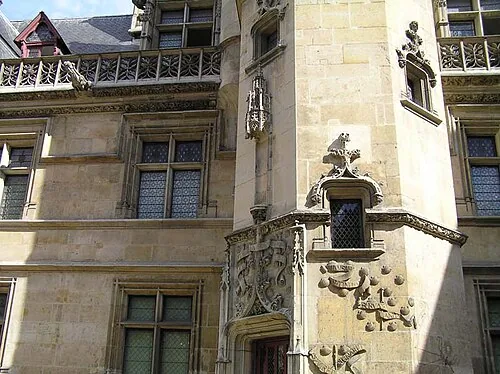
The Musee de Cluny, formally the Musee national du Moyen Age, is in the Latin Quarter at the corner of boulevard Saint-Michel and boulevard Saint-Germain, and occupies two joined buildings: the late fifteenth-century town house of the abbots of Cluny and the surviving north block of the Roman baths of Lutetia, built around AD 200. Its best-known holding is the set of six Lady and the Unicorn tapestries, woven about 1500. A long reorganisation completed in 2022 gave it a new entrance and a clear chronological route.
Open in the planner →Getting there
Cluny-La Sorbonne on line 10 is at the door, and Saint-Michel on line 4 or Saint-Michel-Notre-Dame for RER B and C are four to five minutes away. Odeon on lines 4 and 10 is five minutes west. From Chatelet it is one stop on line 4 then a short walk, or about fifteen minutes on foot across the Pont au Change. The entrance is on place Paul-Painleve, on the quieter courtyard side rather than the boulevard.
What you see
The route starts in the Roman rooms and the frigidarium, a huge intact vaulted hall of the baths with its original masonry and the Pillar of the Boatmen from the first century standing in it. From there you move through medieval stone sculpture, including the heads from the kings' gallery of Notre-Dame, smashed in 1793 and dug up on rue de la Chaussee-d'Antin in 1977. Then come the stained glass panels from the Sainte-Chapelle workshops, lit from behind at eye level, ivories, enamels and goldsmiths' work, and the gold crowns of the Visigothic treasure of Guarrazar. The tapestry rooms are the climax: the Lady and the Unicorn hangs in a dim circular room designed around it, six panels of the five senses and a sixth whose meaning is still argued over. The abbots' house itself, with its spiral stair turret, chapel vault and small walled garden, is part of what you are looking at.
What to pair it with
The Sorbonne and the Pantheon are five and ten minutes uphill, Shakespeare and Company and the river are ten minutes north, and the Jardin du Luxembourg is twelve minutes west.
When to go
Weekday mornings are reliably calm, and this is one of the few central Paris museums where that is still true in summer. Weekend afternoons and the free days fill the tapestry room, which is small and dim and uncomfortable when crowded. The museum closes one day a week and runs a late opening on one evening, which is a good quiet slot; check before you go.
What is hard about it
The tapestry room is deliberately dark for conservation, so the colours are muted in person and photographs of them look better than the originals do; some visitors find this the main letdown. The collection is medieval and specialised, and without any interest in the period an hour and a half can feel long. The historic building means uneven floors, steps between levels and a circuit that is only partly step-free, though the post-2022 entrance improved access; check before you go if that matters. Timed online booking is normally advised and the Roman frigidarium is cold in any season.
Common questions
How long do you need at the Musee de Cluny?
Ninety minutes covers the whole route comfortably. An hour is enough if you come mainly for the tapestries and the Roman baths.
What are the Lady and the Unicorn tapestries?
Six wool and silk hangings woven around 1500, five showing the senses and one inscribed A Mon Seul Desir whose subject is still debated. They are shown together in their own low-lit room.
Can you see the Roman baths without going in?
Partly. The outer walls of the frigidarium are visible from boulevard Saint-Michel, but the vaulted hall and the Pillar of the Boatmen are inside the museum.
Nearby
- PanthéonNeoclassical mausoleum of the Republic's great, with Foucault's pendulum
- Jardin du LuxembourgFormal gardens round the Senate, with green chairs and a toy-boat pond
- Institut du monde arabeNouvel's photo-sensitive screen wall, and a roof terrace above the Seine
- Jardin des PlantesThe botanical garden, with greenhouses and the natural history galleries
- Grand Mosque of ParisHispano-Moorish courtyards, a tiled patio and a tearoom
- Shakespeare and Company (bookstore)The English-language bookshop facing Notre-Dame across the river
More of the same kind
- LouvreThe largest art museum on earth, in a palace, behind a glass pyramid
- Musée d'OrsayImpressionism in a converted railway station, under the great clock
- Centre PompidouModern art behind the inside-out pipes of Rogers and Piano
- Musée RodinThe Thinker and the Gates of Hell in a mansion with a sculpture garden