Musée d'Orsay
Impressionism in a converted railway station, under the great clock
- Area 7th arrondissement
- Type Museum
- Time needed 2h 30m
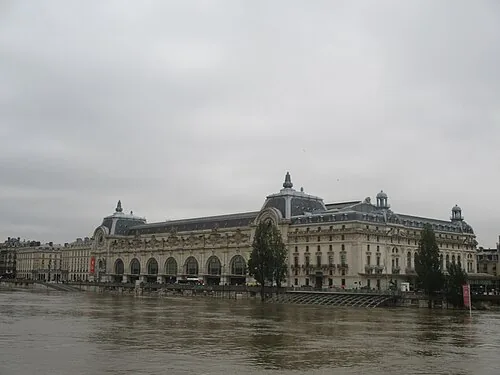
The Musee d'Orsay holds the national collection of French art from 1848 to 1914, which in practice means the greatest concentration of Impressionist and Post-Impressionist painting anywhere. It occupies the Gare d'Orsay, a railway station built for the 1900 exposition, closed to long-distance trains in 1939 and converted to a museum in 1986; the great clock and the barrel-vaulted hall are the station's. It sits on the Left Bank directly across the river from the Tuileries.
Open in the planner →Getting there
Musee d'Orsay on RER C is the station under the building, one stop from Saint-Michel and about ten minutes from Chatelet with a change. Solferino on Metro line 12 is a five minute walk. From the Louvre, walk: over the Pont Royal or the footbridge and you are there in 15 minutes, which is quicker than any train. The Batobus river stop is at the door and is a genuinely good way to arrive if you are coming from the Eiffel Tower or the Hotel de Ville.
What you see
The ground floor runs the length of the old train shed under the glass vault, with nineteenth-century sculpture down the middle of the nave and the early rooms — Courbet, Millet, the pre-Impressionist generation, Manet's Olympia and the Dejeuner sur l'herbe — opening off the sides. Take the lift or escalator straight to the top floor rather than working up, because the Impressionist galleries are there and they fill up: Monet including Rouen cathedral and the water lilies of the earlier series, Renoir's Bal du moulin de la Galette, Degas dancers and the small bronze and wax figures, Van Gogh's self-portrait and the Church at Auvers, Cezanne's card players and Sainte-Victoire landscapes. Off those rooms, the cafe behind the clock face lets you look out through the glass dial at the Seine and the Louvre, which is the single best photograph in the building. The middle level has the Art Nouveau rooms with Guimard and Gallé furniture, the large academic and Symbolist canvases, Rodin and Maillol sculpture, and the sumptuous reconstructed ballroom of the old station hotel. The scale model of the Opera quarter set under a glass floor is easy to walk over without noticing.
What to pair it with
The Louvre is a 15 minute walk over the river. The Rodin museum and Les Invalides are 15 minutes west. The Orangerie, with the large Monet water lilies, is across the Pont Royal in the Tuileries.
When to go
Open at opening and go up to the top floor first, or come for the one late evening a week, which is the best time in the building. The museum closes one day a week. Sunday mornings and the day after the closed day are both busier than they look. The glass vault makes the nave bright and hot in summer and it is a pleasant grey-light space in winter. Autumn and winter weekday mornings are the quiet period.
What is hard about it
The top-floor Impressionist rooms are the most congested gallery space in Paris after the Mona Lisa room, and in season you queue inside the museum to shuffle past the famous Van Goghs. Timed online booking is normally needed. Works travel constantly to other exhibitions, so a specific painting you have come for may simply not be on the wall — check the collection database before you go if it matters. The building's conversion gives awkward circulation: the levels do not line up, the signage is poor, and people lose a lot of time going back down to go up. The cafe behind the clock has a queue of its own. Bag rules are strict and the cloakroom line adds time at both ends.
Common questions
How long do you need at the Musee d'Orsay?
Two to three hours is right for the top floor and a pass through the nave. Doing the middle level properly as well takes four.
Should you do the Louvre and Orsay on the same day?
It is possible, since they are 15 minutes apart, but it is a lot of looking. If you must, give Orsay the morning and the Louvre a targeted two hours after a long lunch.
Where is the famous clock window?
On the top floor, behind the cafe at the far end of the Impressionist galleries; there is a second, smaller clock face viewpoint on the same level.
Nearby
- Musée RodinThe Thinker and the Gates of Hell in a mansion with a sculpture garden
- Les InvalidesThe gilded dome over Napoleon's tomb, and the army museum beneath
- Pont Alexandre IIIThe most ornate bridge in Paris, gilded at all four corners
- Musée du Quai Branly - Jacques ChiracArt of Africa, Asia, Oceania and the Americas behind a living wall
- Rue ClerA short market street near the Invalides, cobbled and pedestrian
More of the same kind
- LouvreThe largest art museum on earth, in a palace, behind a glass pyramid
- Centre PompidouModern art behind the inside-out pipes of Rogers and Piano
- Musée de l'OrangerieMonet's Water Lilies in two oval rooms built for them
- Musée PicassoThe largest Picasso collection anywhere, in a Marais mansion
Part of these routes
- The Left BankImpressionists in a station, Rodin's garden, and the streets of Saint-Germain.
- Paris in three daysThe short list, ordered so each day holds together and nothing is crossed twice.
- Paris in five daysA fuller first visit: the island, the Louvre, the Left Bank, Montmartre and Versailles.
- Paris at lengthEverything the other routes cover, spread over unhurried days with nothing rushed.