Les Invalides
The gilded dome over Napoleon's tomb, and the army museum beneath
- Area 7th arrondissement
- Type Landmark
- Time needed 2h
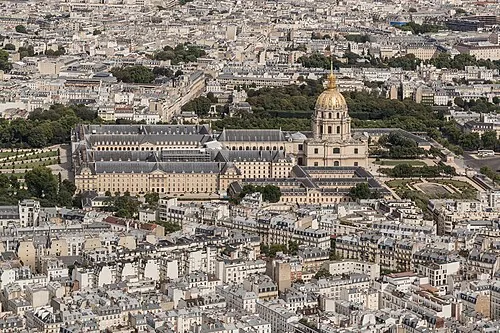
The Hôtel des Invalides was built from 1670 under Louis XIV as a home and hospital for disabled soldiers, and parts of it still serve veterans. Behind its 196-metre facade are two churches: the soldiers' church and, beyond it, the gilded Dome church, under which Napoleon's body was placed in 1861 in a sarcophagus of red quartzite. The rest of the complex houses the Musée de l'Armee, one of the largest military collections in the world, running from medieval armour to the Second World War. It is in the 7th arrondissement, with a long lawn in front of it reaching down to the Seine.
Open in the planner →Getting there
Invalides station is served by Métro lines 8 and 13 and by RER C, and comes up at the north-east corner of the esplanade, about 15 minutes from Châtelet with one change. La Tour-Maubourg on line 8 and Varenne on line 13 are each a 5 minute walk and are often more convenient for the museum entrance. From the right bank you can walk over Pont Alexandre III and straight down the esplanade, which takes about 10 minutes and is the best approach. The Eiffel Tower is about 25 minutes west on foot along the rue de Grenelle.
What you see
Come in from the esplanade and cross the Cour d'Honneur, a vast gravel courtyard with two tiers of arcades and a line of bronze cannon along the walls; the dormer windows above each have a different carved trophy. The soldiers' church, Saint-Louis-des-Invalides, opens off the courtyard, hung with captured battle flags and with an opening behind the altar through which you can see into the Dome church. The Dome church itself is entered from the south side: under the gilded cupola and its painted ceiling, a circular opening in the floor looks down into the crypt where the sarcophagus sits, ringed by stone figures of victories and by reliefs of Napoleon's reforms, and you then descend to walk round it. Side chapels hold the tombs of Vauban, Foch, Turenne and Napoleon's brothers. The Musee de l'Armee takes the wings: the medieval and Renaissance arms and armour department is the strongest part, with royal parade armours and a long run of edged weapons; the seventeenth to nineteenth century galleries follow the French army through Louis XIV to the Empire, with Napoleon's hat and coat, his campaign tent and his horse's skeleton; and the modern wing covers the two world wars in detail across several floors. Upstairs under the roof is the Musee des Plans-Reliefs, a collection of enormous scale models of fortified towns made for the army from the seventeenth century on.
What to pair it with
The Musée Rodin is a ten-minute walk and the two make a natural pair. Pont Alexandre III is at the bottom of the esplanade, and the Musée d'Orsay is about fifteen minutes east along the river.
When to go
Morning is best, both for the light on the dome from the esplanade and because the museum fills from late morning. Allow for the fact that this is a large site and the ticket covers several separate buildings, so a short visit will not do it. Closed one day a week on some schedules and on a few public holidays, so check before you go. The Dome church is cold in winter and the courtyard offers no shelter. Floodlighting on the dome at night, seen from Pont Alexandre III, is one of the better free sights in the city.
What is hard about it
It is big and the ticket covers more than most people can absorb: visitors who allow an hour see the tomb and little else, and visitors who try to do all of it get tired. The military galleries are dense, text-heavy and traditionally displayed, with limited English on some labels, and they are a poor fit for younger children despite the cannon. There are stairs throughout, including down to the crypt, and the older wings are hard to navigate with a wheelchair or pushchair; check accessibility routes in advance. Security checks at the entrance can be slow. The courtyard and esplanade are entirely exposed, and the gilding looks far better in sun than under grey cloud.
Common questions
How long do you need at Les Invalides?
Two hours as a minimum for Napoleon's tomb, both churches and one wing of the museum. Half a day if you intend to see the whole army museum.
Is Napoleon's tomb included in the museum ticket?
Yes, a single ticket normally covers the Dome church with the tomb, the soldiers' church and the Musee de l'Armee. Check the current arrangement before booking.
Which part should you see if time is short?
The Dome church and crypt, then the medieval arms and armour rooms, which are the strongest section of the museum. Skip the modern wing on a short visit.
Nearby
- Musée d'OrsayImpressionism in a converted railway station, under the great clock
- Musée RodinThe Thinker and the Gates of Hell in a mansion with a sculpture garden
- Pont Alexandre IIIThe most ornate bridge in Paris, gilded at all four corners
- Musée du Quai Branly - Jacques ChiracArt of Africa, Asia, Oceania and the Americas behind a living wall
- Rue ClerA short market street near the Invalides, cobbled and pedestrian
More of the same kind
- Eiffel TowerGustave Eiffel's 330-metre iron tower, the one unmistakable thing on the skyline
- Arc de TriompheNapoleon's arch at the top of the Champs-Élysées, with a roof terrace
- Palais GarnierGarnier's opera house, all marble staircase, gold and Chagall ceiling
- Place de la ConcordeThe largest square in Paris, with an Egyptian obelisk at its centre
Part of these routes
- The Eiffel Tower and the InvalidesThe tower from below and above, the gilded dome, and the terrace that frames it all.
- Paris in five daysA fuller first visit: the island, the Louvre, the Left Bank, Montmartre and Versailles.
- Paris at lengthEverything the other routes cover, spread over unhurried days with nothing rushed.