Eiffel Tower
Gustave Eiffel's 330-metre iron tower, the one unmistakable thing on the skyline
- Area Champ-de-Mars
- Type Landmark
- Time needed 2h
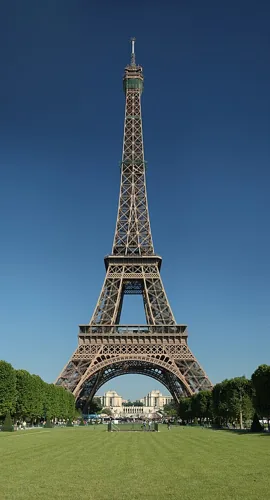
Gustave Eiffel's iron tower was finished in 1889 for the world's fair and stands 330 metres over the Champ-de-Mars, on the Left Bank beside the Seine. It was meant to come down after twenty years and survived because it was useful as a radio mast. People go for the view, the lifts and the fact that the structure itself is the exhibit.
Open in the planner →Getting there
Bir-Hakeim on Metro line 6 is the closest station and the approach along the viaduct gives you the tower growing in front of you; it is roughly 20 minutes from Chatelet with one change. RER C to Champ de Mars-Tour Eiffel drops you in the park on the south side. Ecole Militaire on line 8 is a slightly longer flat walk up the Champ-de-Mars lawn, which is the better arrival if you want the classic head-on photograph. From the far bank, Trocadero on line 9 gives the single best first sight of it, then a walk down through the gardens and over the Pont d'Iena — about ten minutes downhill.
What you see
Security screening happens at the perimeter under the tower, so the first thing you see is the underside of the arches and the iron lattice overhead. The first floor has a glass floor section looking straight down, a walk-round gallery with panels on how the thing was built, and the quietest views of the Trocadero and the Champ-de-Mars axis. The second floor is where the view actually works: you are high enough to read the street pattern, the Invalides dome, the Grand Palais, the curve of the river and the towers of La Defense, but still low enough to pick out individual buildings. The top is reached by a separate small lift from the second floor, enclosed except for a sheltered upper platform, with a reconstruction of Eiffel's own office near the summit. On the way back down, the stairs from the second floor to the first and then to the ground are worth taking if your knees allow, because the structure is far more interesting from inside it than from the lift.
What to pair it with
The Trocadero gardens and the Palais de Chaillot sit directly across the river. Les Invalides and the Rodin museum are a flat 20 minute walk east. The Arc de Triomphe is a short hop on line 6 or a longer walk up the Avenue d'Iena.
When to go
First entry of the morning and the last couple of hours before closing are the two calm windows; the middle of the day in July and August is the worst of it. Late spring and early autumn give long light and manageable queues. Sunset from the second floor is the view most people want, which is exactly why that slot books out first — going up an hour earlier and staying through dusk gets you both the daylight panorama and the lit city. The tower itself is floodlit after dark with a brief sparkle on the hour, best watched from the Champ-de-Mars or Trocadero rather than from inside it. Clear days after rain give the sharpest long views; in low cloud the summit can be inside the cloud and worth nothing.
What is hard about it
This is the most heavily queued structure in Paris and the waits compound: a security line at the perimeter, then a lift line, then another line at the second floor for the summit lift. Timed tickets are normally needed and the good evening slots go weeks ahead; turning up on the day in season can mean two hours of standing. The lifts break down and the summit closes in high wind without warning, and refunds for a closed summit are not instant. It is genuinely vertiginous at the top and the enclosed upper platform is cramped when full. Street sellers around the base are persistent. If the view is all you want, the Montparnasse tower or the Arc de Triomphe terrace cost less trouble and include the Eiffel Tower in the picture, which this one cannot.
Common questions
How long do you need at the Eiffel Tower?
Allow about two hours from joining the security queue to walking out, if you go to the second floor. Adding the summit pushes it closer to three.
Can you go up the stairs instead of the lift?
Yes, as far as the second floor, on a separate and usually shorter stair ticket; the summit is lift-only. It is around 670 steps to the second floor.
Is it worth paying for the summit?
Only if height itself is the point. The second floor gives the better, more readable view of the city, and the summit is more enclosed and more crowded.
More of the same kind
- Arc de TriompheNapoleon's arch at the top of the Champs-Élysées, with a roof terrace
- Palais GarnierGarnier's opera house, all marble staircase, gold and Chagall ceiling
- Place de la ConcordeThe largest square in Paris, with an Egyptian obelisk at its centre
- Les InvalidesThe gilded dome over Napoleon's tomb, and the army museum beneath
Part of these routes
- The Eiffel Tower and the InvalidesThe tower from below and above, the gilded dome, and the terrace that frames it all.
- Paris in three daysThe short list, ordered so each day holds together and nothing is crossed twice.
- Paris in five daysA fuller first visit: the island, the Louvre, the Left Bank, Montmartre and Versailles.
- Paris at lengthEverything the other routes cover, spread over unhurried days with nothing rushed.