Arc de Triomphe
Napoleon's arch at the top of the Champs-Élysées, with a roof terrace
- Area Champs-Élysées
- Type Landmark
- Time needed 1h
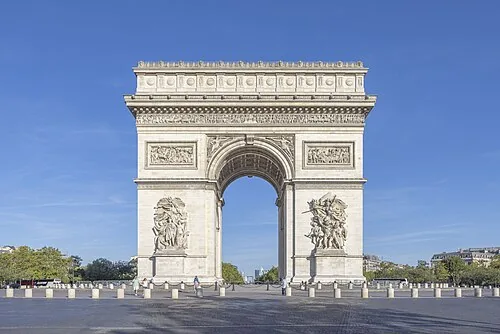
Napoleon ordered the Arc de Triomphe in 1806 after Austerlitz; it was finished in 1836, long after he was dead, and stands at the centre of the Place Charles de Gaulle where twelve avenues meet. The tomb of the Unknown Soldier lies beneath it with a flame that has been relit every evening since 1923. The roof terrace, 50 metres up, gives the view that includes the Eiffel Tower, which is the real reason to buy a ticket.
Open in the planner →Getting there
Charles de Gaulle-Etoile is served by Metro lines 1, 2 and 6 and by RER A, and is about ten minutes from Chatelet on line 1 or the RER. Do not try to cross the roundabout on foot: there is a pedestrian underpass from the north side of the Champs-Elysees, near the top of the avenue, and it is the only legal and sane way in. Signs point to it from the station exits. From the Eiffel Tower, line 6 from Bir-Hakeim runs direct in about eight minutes.
What you see
At ground level, the four large relief groups on the piers are the thing to look at properly, and the one facing the Champs-Elysees — Rude's Departure of the Volunteers, usually called the Marseillaise — is the best of them. The inner faces of the arch carry the names of hundreds of generals and battles of the Revolutionary and Napoleonic wars, carved in column after column. The tomb and the flame sit in the middle, with the rekindling ceremony each evening. Inside, a spiral stair of around 280 steps climbs the pier to a small museum level with displays on the arch's construction and the Unknown Soldier, then a last short flight to the terrace. On the roof the twelve avenues radiate out below you in a way no map makes clear, with the Champs-Elysees running down to the Place de la Concorde and the obelisk on one axis, the Grande Arche at La Defense closing the view the other way, and the Eiffel Tower off to the south-west.
What to pair it with
The Champs-Elysees runs down from the door to the Place de la Concorde and the Tuileries. The Eiffel Tower and Trocadero are a short ride or a 25 minute walk. The Palais Garnier is 15 minutes on Metro line 1 and then a short walk.
When to go
Late afternoon into dusk is the slot worth planning for: the city lights come on, the avenues turn into lines of traffic lights and headlamps, and the Eiffel Tower sparkles on the hour. The terrace is open into the evening, later than most viewpoints. Mornings are quiet and the light is behind you looking down the Champs-Elysees. The 14 July and 11 November ceremonies close or heavily restrict the site, and the Champs-Elysees is closed for several Sundays and event days each year, which changes the view but also the access.
What is hard about it
There is no lift to the terrace on the normal route — around 280 spiral steps, narrow, one-way, and tiring in heat; a lift exists but is reserved for visitors with reduced mobility and needs arranging. The terrace is exposed, cold and windy in winter, and small enough to feel crowded at sunset when everyone arrives at once. Protective mesh and railings get into photographs. Timed tickets are normally needed in season. People who expect to go inside a monument find there is very little inside: a stairwell, a modest museum room and a roof. The underpass entrance confuses visitors every day and some give up and photograph it from the pavement, which is a reasonable outcome.
Common questions
How long do you need at the Arc de Triomphe?
An hour covers the climb, the terrace and a proper look at the reliefs and the tomb. Add waiting time at sunset.
How do you get to the Arc de Triomphe without crossing the traffic?
Use the pedestrian underpass signed from the north side of the Champs-Elysees near the top of the avenue, or follow the signs from the Charles de Gaulle-Etoile station exits. Crossing the roundabout on the surface is not permitted.
Is the view better than from the Eiffel Tower?
Many people prefer it, because the Eiffel Tower is in it and the twelve-avenue star only makes sense from directly above. It is lower, so the horizon is closer.
Nearby
- Champs-ÉlyséesThe two-kilometre avenue from the Concorde to the Arc de Triomphe
- Grand PalaisA glass and iron nave built for the 1900 World's Fair
- Petit PalaisThe city's fine-art museum, free, with a garden courtyard
More of the same kind
- Eiffel TowerGustave Eiffel's 330-metre iron tower, the one unmistakable thing on the skyline
- Palais GarnierGarnier's opera house, all marble staircase, gold and Chagall ceiling
- Place de la ConcordeThe largest square in Paris, with an Egyptian obelisk at its centre
- Les InvalidesThe gilded dome over Napoleon's tomb, and the army museum beneath