Champs-Élysées
The two-kilometre avenue from the Concorde to the Arc de Triomphe
- Area Champs-Élysées
- Type Neighbourhood
- Time needed 1h
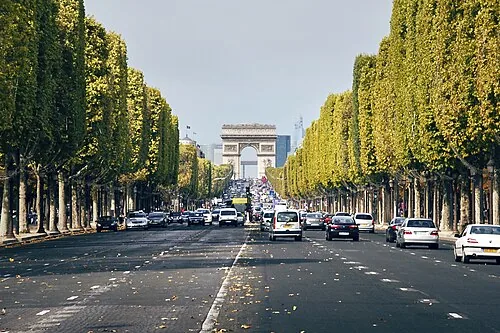
The Avenue des Champs-Élysées runs for about two kilometres from Place de la Concorde up to the Arc de Triomphe, climbing gently the whole way. It was laid out as a garden promenade in the seventeenth century and became a commercial street in the nineteenth. Today it is the route of the Bastille Day parade and the final laps of the Tour de France. It is a walk rather than a sight, and there is nothing to enter.
Open in the planner →Getting there
Start at the bottom: Concorde on Métro lines 1, 8 and 12, about 7 minutes from Châtelet on line 1. The avenue is then served along its length by Champs-Élysées–Clemenceau (lines 1 and 13), Franklin D. Roosevelt (lines 1 and 9) and George V (line 1), with Charles de Gaulle–Étoile (lines 1, 2 and 6, plus RER A) at the top. RER A from Châtelet–Les Halles reaches Étoile in about 6 minutes if you would rather walk downhill. Walking the full length takes 25 to 35 minutes without stops.
What you see
The two halves are quite different, and it is worth knowing which one you are walking. The lower half, from the Concorde up to the Rond-Point des Champs-Élysées, is the better walk: broad gravel paths under plane trees, the Grand Palais and Petit Palais on your left-hand side, the Théâtre Marigny and the Espace Pierre Cardin pavilions among the greenery, and almost no shops. The upper half, from the Rond-Point to the Arc, is chain shops, flagship stores, car showrooms, cinemas and fast-food outlets along wide pavements, and it looks much the same as a high street anywhere. There are a few grand exceptions in the upper stretch, including the covered arcades and courtyards you can cut into off the main pavement. The avenue ends at the Arc de Triomphe, which you reach by the underpass, never across the traffic.
What to pair it with
Place de la Concorde is at the foot of the avenue and the Arc de Triomphe at its head. The Grand Palais and Petit Palais sit beside the lower half, and Pont Alexandre III is a short walk down from them towards the river.
When to go
Early morning on a weekday is quiet and the light runs up the avenue from behind you. Saturday afternoon is the busiest it gets, with the upper half shoulder to shoulder. Autumn and winter evenings give you the strings of lights in the trees, which are switched on from late November. The avenue closes to traffic for the Bastille Day parade and for the Tour de France finish, and on some Sundays each month it is pedestrianised, which is far the most pleasant time to be on it.
What is hard about it
Be clear about what this is: the upper half is a chain-store high street with heavy crowds, aggressive pavement touts near the Métro entrances and prices on the cafe terraces well above what the same coffee costs two streets away. The lower half is a genuinely good tree-lined walk, but many people only do the upper stretch and come away disappointed. It is uphill from the Concorde, exposed in wet or cold weather, and pickpocketing is common on the crowded pavements and in the Métro stations along it. There is nothing to book and nothing to go inside, so if you are short of time it is reasonable to skip.
Common questions
How long do you need on the Champs-Élysées?
Allow 45 minutes to an hour to walk it end to end with a few stops. If you only want the better part, walk the lower half from the Concorde to the Rond-Point in about 20 minutes.
Which direction should you walk it?
Bottom to top gives you the Arc de Triomphe growing in front of you the whole way. Top to bottom is downhill and ends with the obelisk and the Tuileries.
Is the shopping worth it?
Only if you want the specific flagship stores. The brands in the upper half are the same international chains found in most large cities, and the smaller streets off the avenue are more interesting.
Nearby
- Arc de TriompheNapoleon's arch at the top of the Champs-Élysées, with a roof terrace
- Grand PalaisA glass and iron nave built for the 1900 World's Fair
- Petit PalaisThe city's fine-art museum, free, with a garden courtyard
More of the same kind
- Canal Saint-MartinIron footbridges, plane trees and nine locks through the 10th
- MontmartreThe hill village the city grew around, steep, cobbled and crowded
- Place du TertreThe small square behind Sacré-Cœur, full of portrait painters
- Île Saint-LouisA single seventeenth-century street on an island, almost unchanged