Montmartre
The hill village the city grew around, steep, cobbled and crowded
- Area Montmartre
- Type Neighbourhood
- Time needed 1h 30m
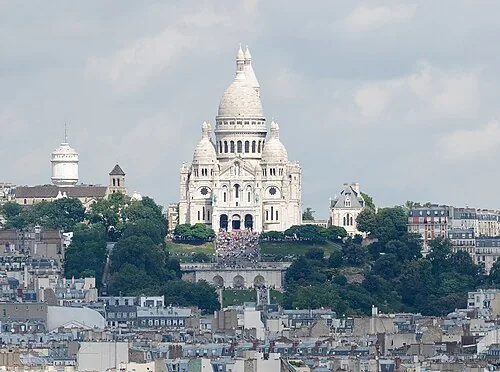
Montmartre is the hill at the northern edge of central Paris, about 130 metres high, annexed by the city in 1860 and still laid out like the village it was. It is a district rather than a single attraction: cobbled lanes, stairways, a surviving windmill or two, a working vineyard and the white bulk of Sacre-Coeur on the summit. Treat it as a walk of an hour and a half or more, done on foot and uphill.
Open in the planner →Getting there
Abbesses on line 12 is the usual entry, and its lift is worth waiting for because the spiral staircase out is long. Anvers on line 2 puts you at the foot of the gardens below Sacre-Coeur, next to the funicular that climbs the last stretch on a Metro ticket. Lamarck-Caulaincourt on line 12 and Blanche on line 2 approach from the north and south-west and are both gentler walks. From Chatelet reckon on twenty to twenty-five minutes on line 4 changing at Barbes-Rochechouart for line 2, or line 1 to Concorde then line 12.
What you see
From Abbesses, go up rue des Trois Freres and rue Ravignan to place Emile-Goudeau, where the Bateau-Lavoir studio block stood and Picasso worked. Rue Lepic climbs from there past the two surviving mills, the Moulin Radet and the Moulin de la Galette, to the corner of rue Girardon. Turn down rue de l'Abreuvoir, the most photographed lane on the hill, and at the bottom you meet the Clos Montmartre, the small municipal vineyard on rue des Saules, with the pink shuttered Au Lapin Agile cabaret on the corner. Rue Saint-Vincent runs round behind it to the cemetery of Saint-Vincent. Back up the other way are the church of Saint-Pierre de Montmartre, which is twelfth-century and the oldest thing on the hill, the Musee de Montmartre with Renoir's garden, and the water tower that reads as a second spire from below. The terrace in front of Sacre-Coeur gives the long southward view over the city.
What to pair it with
Sacre-Coeur and Place du Tertre are on the summit and part of the same walk. The Montmartre cemetery lies below the west side, and Pigalle and the Musee de la Vie Romantique are a short descent to the south.
When to go
Before about ten in the morning the lanes are close to empty and the light is on the eastern slope, which is the best combination the hill offers. From midday to late afternoon, and all weekend, the summit streets are packed. Late afternoon and early evening suit the south-facing terrace view and the cafe streets below. Winter mornings are cold but genuinely quiet.
What is hard about it
It is steep and it is almost all steps and cobbles, so it is hard work in the heat and poor going with a pushchair, a suitcase or weak knees. The streets immediately around the summit are given over to souvenir shops and indifferent restaurants at inflated prices. Pickpocketing is a real problem on the stairs below Sacre-Coeur and around Anvers, and so is the friendship-bracelet approach on the lower steps, which is persistent and best met by walking on without engaging. Nothing here needs a ticket, but nothing here is quiet either.
Common questions
How long do you need in Montmartre?
An hour and a half covers the main loop at a steady pace. Two and a half hours is better if you want the vineyard, a museum and a sit down.
Is there a way up that avoids the steps?
Yes. The funicular from square Louise-Michel runs on a standard Metro ticket, and the Montmartrobus works its way up the back of the hill by road.
Can you visit the vineyard?
Not normally. The Clos Montmartre is fenced and opens only for occasional events, but you can see all of it from rue des Saules.
Nearby
- Sacré-Cœur, ParisThe white basilica on the butte, and the best free view in the city
- Place du TertreThe small square behind Sacré-Cœur, full of portrait painters
More of the same kind
- Champs-ÉlyséesThe two-kilometre avenue from the Concorde to the Arc de Triomphe
- Canal Saint-MartinIron footbridges, plane trees and nine locks through the 10th
- Île Saint-LouisA single seventeenth-century street on an island, almost unchanged