Sacré-Cœur, Paris
The white basilica on the butte, and the best free view in the city
- Area Montmartre
- Type Church
- Time needed 1h
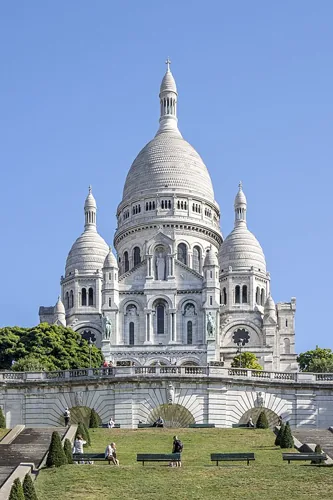
The Basilique du Sacré-Coeur stands on the butte of Montmartre, the highest natural point in Paris, and was built between 1875 and 1914 as a national act of penance after the defeat of 1870 and the Commune. The stone is travertine that whitens as it weathers, which is why it stays pale. Entry to the basilica is free, the terrace in front of it is one of the best open views of the city, and both are extremely busy.
Open in the planner →Getting there
Anvers on Metro line 2 is the usual approach, about 15 minutes from Chatelet with a change, then a walk up the Rue de Steinkerque past the fabric shops to the funicular or the steps. The funicular up the hill takes a standard Metro ticket. Abbesses on line 12 is nearer the top but its own exit is a deep spiral staircase unless you take the lift. Lamarck-Caulaincourt, also on line 12, puts you on the quiet north side of the hill and gives a far more pleasant walk up through residential streets with no crowds and no steps to speak of — this is the arrival locals use.
What you see
The terrace comes first, and most of the time people spend here is spent on it: the view runs south over the roofs with the Pantheon dome, the Centre Pompidou, the Montparnasse tower and, off to the right, the Eiffel Tower. Inside, the basilica is darker and plainer than the exterior suggests, and the thing to look at is the apse mosaic of Christ with outstretched arms, one of the largest in the world, above the high altar. Perpetual adoration has been maintained here continuously since 1885, so there is always someone praying and the nave is kept quiet. Two paid extras branch off: the crypt below, and the dome, reached by a long narrow spiral stair, which gives a higher 360-degree view and is the better of the two if you only do one. Outside, walk round the east end for the apse and the equestrian statues on the facade, then carry on uphill to the Place du Tertre behind, the church of Saint-Pierre de Montmartre next door, which is far older than the basilica and nearly always empty, and the vineyard and windmills on the far slope.
What to pair it with
Place du Tertre and the Montmartre museum are two minutes behind the basilica. Saint-Pierre de Montmartre is next door. The Moulin Rouge and the Pigalle area are at the bottom of the hill.
When to go
Early morning is the only time the terrace is calm, and the light is best in the late afternoon looking south, though the sun is then in your face for photographs. Sunset is the busiest hour of the day, with crowds sitting on the steps and buskers working them. Summer days are solid with people from mid-morning until late. Winter mornings on the north-side approach are genuinely quiet. The basilica keeps long hours including the evening, unlike the dome and crypt, which close earlier.
What is hard about it
The hill is the cost: steep streets and long flights of steps whichever way you come, and the funicular queues or breaks down. The steps and terrace attract persistent bracelet sellers and shell-game operators, and pickpocketing in the crowd on the steps and in the Anvers Metro corridors is a known problem rather than a rumour. The dome climb is around 300 narrow steps with no lift and is not for anyone unsure on stairs. Inside, the building disappoints visitors expecting Gothic — it is late nineteenth-century and reads as such — and photography is discouraged in the nave. The Place du Tertre behind is a tourist trap of portrait artists and overpriced terraces. On a hazy day the view, which is the main reason to come, is flat.
Common questions
How long do you need at Sacré-Coeur?
An hour covers the terrace, the basilica interior and a walk round the outside. Add half an hour for the dome.
Is there a way up that avoids the steps?
Yes. The funicular from the Anvers side takes a standard Metro ticket, and coming out at Lamarck-Caulaincourt on line 12 gives a gentle walk up the north side with almost no steps.
Is it free to go inside?
The basilica itself is free to enter. The dome and the crypt are separately ticketed and close earlier than the church.
Nearby
- MontmartreThe hill village the city grew around, steep, cobbled and crowded
- Place du TertreThe small square behind Sacré-Cœur, full of portrait painters
More of the same kind
- Notre-Dame de ParisThe Gothic cathedral on the Île de la Cité, reopened after the 2019 fire
- Sainte-ChapelleFifteen windows of thirteenth-century glass in a single upper room
- PanthéonNeoclassical mausoleum of the Republic's great, with Foucault's pendulum
- Basilica of Saint-DenisThe first Gothic building, and the burial place of the French kings
Part of these routes
- MontmartreThe hill: the white basilica, the painters' square, the windmill at the bottom.
- Paris from aboveFour high places, ordered so the light and the queues fall the right way.
- Paris in three daysThe short list, ordered so each day holds together and nothing is crossed twice.
- Paris in five daysA fuller first visit: the island, the Louvre, the Left Bank, Montmartre and Versailles.
- Paris at lengthEverything the other routes cover, spread over unhurried days with nothing rushed.