Sainte-Chapelle
Fifteen windows of thirteenth-century glass in a single upper room
- Area Île de la Cité
- Type Church
- Time needed 45m
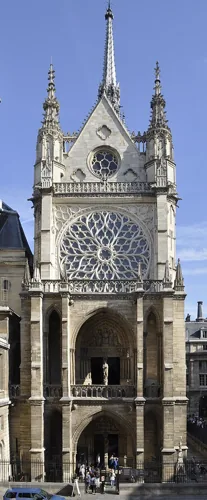
Sainte-Chapelle was built in the 1240s inside the royal palace on the Ile de la Cite to house relics of the Passion that Louis IX had bought at vast expense. The upper chapel is one room wrapped in fifteen lancet windows of thirteenth-century stained glass, about two-thirds of it original, with a rose window added in the fifteenth century. It is small, it takes 45 minutes, and on a bright day there is nothing else like it in Europe.
Open in the planner →Getting there
Cite on Metro line 4 is two stops from Chatelet, about four minutes, and the entrance on the Boulevard du Palais is a two minute walk. Saint-Michel-Notre-Dame on RER B and C and Metro line 4 is a five minute walk over the Pont Saint-Michel. From the Right Bank, Chatelet itself is walkable in about ten minutes over the Pont au Change. The chapel sits inside the working law courts complex, so the queue you join on the pavement is for a security screening shared with the Palais de Justice.
What you see
You enter at ground level into the low lower chapel, which was for the palace servants: dark, squat, painted blue with fleurs-de-lys, vaulted close over your head. It is a deliberate compression, and the tight spiral stair in the corner is the release. The upper chapel opens out as near-continuous glass on all three sides and the effect is the point of the building — the stone is reduced to the minimum needed to hold the windows up. The glazing runs as a narrative from Genesis along the north side round to the Passion and the relics in the apse; the panels are small and high, so the detail needs patience or binoculars rather than a camera. The two carved stone niches flanking the apse were the royal seats. The west rose, in flamboyant tracery, shows the Apocalypse and is the one window that reads easily from the floor. Sit down on the bench along the side wall and give it fifteen minutes; the colour changes as cloud moves.
What to pair it with
The Conciergerie shares the same site and is a two minute walk, often on a joint ticket. Notre-Dame is five minutes east on the same island. The Louvre is 20 minutes west along the quays.
When to go
Bright mid-morning to mid-afternoon is when the glass works; the chapel is small and badly served by dull weather or late winter afternoons, when the windows go flat and grey. Clear cold days in winter give strong low light with few visitors, which is the best combination available. Summer middays are crowded enough that you queue outside and shuffle inside. Occasional evening concerts are held in the upper chapel and are a different, calmer way to see it, though the glass is dark by then.
What is hard about it
The queue is the problem and it is outdoors on the pavement with no shelter, because security for the law courts cannot be skipped and is not fast. Timed tickets help but do not remove the screening line. The visit itself is short, the upper chapel is one room, and at busy times you are standing shoulder to shoulder looking up, which is uncomfortable and limits how long you want to stay. Scaffolding has appeared on sections of the glazing for conservation in the past and may again, which can take a window or two out of play. The spiral stair between the two levels is narrow and there is no step-free route to the upper chapel. Some people find it over-restored; roughly a third of the glass is nineteenth-century replacement.
Common questions
How long do you need at Sainte-Chapelle?
Forty-five minutes is enough, including the lower chapel. The queue outside can easily take as long again.
Is Sainte-Chapelle worth it on a cloudy day?
Less so. The windows depend entirely on direct light, and in flat grey weather the colour drops away — if you have a choice of days, save it for a bright one.
Should you buy a combined ticket with the Conciergerie?
If you have an hour spare, yes; they are the same complex, the combined option is normally offered, and the Conciergerie covers the medieval palace and the Revolutionary prison.
Nearby
- Notre-Dame de ParisThe Gothic cathedral on the Île de la Cité, reopened after the 2019 fire
- Pont NeufDespite the name, the oldest standing bridge over the Seine
- ConciergerieThe medieval royal palace that became the Revolution's prison
- Pont des ArtsThe wooden footbridge between the Louvre and the Institut de France
- Square du Vert-GalantThe willow-shaded prow at the western tip of the island
More of the same kind
- Sacré-Cœur, ParisThe white basilica on the butte, and the best free view in the city
- PanthéonNeoclassical mausoleum of the Republic's great, with Foucault's pendulum
- Basilica of Saint-DenisThe first Gothic building, and the burial place of the French kings
- Saint-Sulpice, ParisThe second largest church in Paris, with Delacroix murals and a gnomon
Part of these routes
- The island and the LouvreThe oldest part of Paris and the largest museum in it, with the river between them.
- Paris in three daysThe short list, ordered so each day holds together and nothing is crossed twice.
- Paris in five daysA fuller first visit: the island, the Louvre, the Left Bank, Montmartre and Versailles.
- Paris at lengthEverything the other routes cover, spread over unhurried days with nothing rushed.