Pont Neuf
Despite the name, the oldest standing bridge over the Seine
- Area Île de la Cité
- Type Landmark
- Time needed 20m
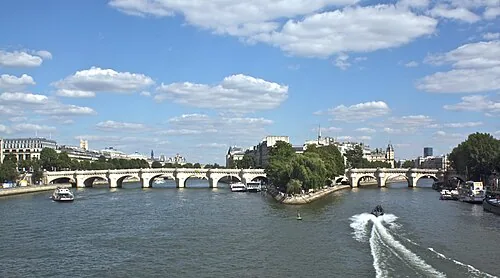
The Pont Neuf was finished in 1607 and, despite a name that means new bridge, it is the oldest bridge still standing across the Seine. It crosses in two spans over the western tip of the Île de la Cité, so it is really two bridges joined by the island. People come for the walk itself: the open parapet, the stone mascarons carved along the cornice, and the long view downstream.
Open in the planner →Getting there
Metro line 7 to Pont Neuf puts you at the Right Bank end; the exit opens almost onto the bridge. From Châtelet it is one stop on line 7 or about a ten minute walk along the quays, so most people simply walk. Line 4 to Cité or Saint-Michel works for the Left Bank end, and RER B and C both stop at Saint-Michel Notre-Dame a few minutes away. The Batobus river stop at Pont Neuf is on the Right Bank quay below the bridge.
What you see
Walk from the Right Bank and the first thing you meet is the bronze equestrian statue of Henri IV on the island platform, facing back towards the Louvre. Behind it, steps go down into the Square du Vert-Galant, a narrow triangle of gravel and trees at water level that is the quietest spot on the island and the best place to watch boats pass. Back on the deck, look over the parapet at the semicircular bays set into the cornice, and at the mascarons, the carved grotesque faces running along both sides. Carry on to the Left Bank for the view back towards the Conciergerie towers, and look upstream at the Samaritaine and the roofline of the Louvre.
What to pair it with
The Conciergerie and Sainte-Chapelle are a short walk east along the island. The Louvre is directly across the Right Bank end, and the Musée d'Orsay is a riverside walk upstream on the Left Bank.
When to go
Free and open at all hours, which makes it one of the few Paris views you can have to yourself. Early morning is empty and the light comes from behind the island. Late afternoon and the hour before dusk give the best downstream light and are also the busiest, as river boats and tour groups converge. Summer brings crowds to the Vert-Galant; in winter the bridge is exposed and the wind off the water is sharp.
What is hard about it
It is a bridge, so a visit is short and there is nothing to go inside. Traffic runs across it and the pavements are narrow in places, so the noise is constant and photographs often have a bus in them. The Square du Vert-Galant is reached by steps with no lift, and it is closed when the river is high. Visitors expecting something ornate are often surprised by how plain the stonework is at close range.
Common questions
How long do you need at the Pont Neuf?
Fifteen to twenty minutes to cross, look at the mascarons and stop at the statue. Add another fifteen if you go down to the Square du Vert-Galant.
Why is the oldest bridge called the new bridge?
It was new when it was built, and the name stuck. It was also the first Paris bridge with no houses on it and the first with raised pavements for pedestrians.
Is there a charge or a ticket?
No. It is a public road and open day and night at no cost.
Nearby
- Notre-Dame de ParisThe Gothic cathedral on the Île de la Cité, reopened after the 2019 fire
- Sainte-ChapelleFifteen windows of thirteenth-century glass in a single upper room
- ConciergerieThe medieval royal palace that became the Revolution's prison
- Pont des ArtsThe wooden footbridge between the Louvre and the Institut de France
- Square du Vert-GalantThe willow-shaded prow at the western tip of the island
More of the same kind
- Eiffel TowerGustave Eiffel's 330-metre iron tower, the one unmistakable thing on the skyline
- Arc de TriompheNapoleon's arch at the top of the Champs-Élysées, with a roof terrace
- Palais GarnierGarnier's opera house, all marble staircase, gold and Chagall ceiling
- Place de la ConcordeThe largest square in Paris, with an Egyptian obelisk at its centre