Notre-Dame de Paris
The Gothic cathedral on the Île de la Cité, reopened after the 2019 fire
- Area Île de la Cité
- Type Church
- Time needed 1h
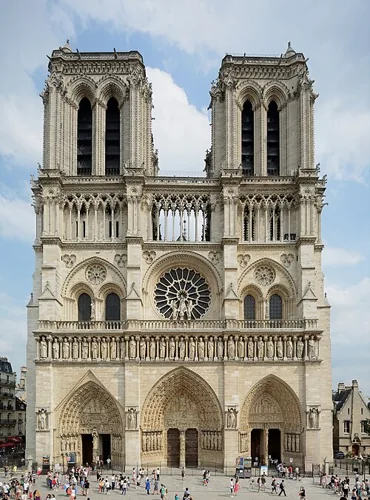
Notre-Dame de Paris is the Gothic cathedral on the Ile de la Cite, begun in 1163 and finished, in its medieval form, roughly two centuries later. The April 2019 fire destroyed the roof and the nineteenth-century spire; the building reopened in December 2024 after a reconstruction that also cleaned the interior stone back to a pale colour nobody alive had seen. Entry to the nave is free, and the cathedral is a working parish church with daily services, not only a monument.
Open in the planner →Getting there
Cite on Metro line 4 is the nearest station, two stops and about four minutes from Chatelet, and leaves a three minute walk east across the island. Saint-Michel-Notre-Dame is served by RER lines B and C and by Metro line 4, and the walk over the Petit Pont is about five minutes with the west front in front of you the whole way. From the Marais side, Hotel de Ville on lines 1 and 11 is an eight minute walk over the Pont d'Arcole. Approaching from the Left Bank along the Quai de Montebello gives the best view of the flying buttresses and the east end, which is the side most people never look at.
What you see
Stand back in the parvis first: the west front is a reading exercise, with the Portal of the Last Judgement in the centre, the Gallery of Kings above, and the rose window between the towers. Inside, the nave now reads as light grey rather than soot-dark, and the shift in the stone colour is the single most noticeable change since the fire. The three rose windows are the thing to spend time on — north and south in the transepts are largely medieval glass and hold their deep blues, the west rose is partly later work. Walk the ambulatory behind the high altar to see the fourteenth-century Virgin and Child against the pillar, the carved choir screen panels along the outside of the choir, and the treasury off the south side, which is a separate paid room. The new liturgical furniture and the reconstructed roof timbers are talked about more than they are visible; the roof is not open to visitors. The towers and their climb to the gallery of chimeras reopened separately from the nave and have their own ticket and their own booking.
What to pair it with
Sainte-Chapelle and the Conciergerie are five minutes west on the same island. The Latin Quarter and Shakespeare and Company are over the Petit Pont. The Pantheon is a 15 minute uphill walk south.
When to go
Early morning on a weekday is the quietest hour in the nave, and the first two hours after opening are the only time it feels like a church rather than a visit. Late afternoon light hits the south rose; mornings favour the north. Sunday and the major feasts bring full services and the nave is given over to worship, with visiting restricted. Summer middays are the worst, and the island is busy from mid-morning in any season. Winter weekday afternoons are genuinely calm.
What is hard about it
Reopening demand has not settled. The nave is free but a timed online reservation is normally needed, slots are released on a rolling short-notice basis and go within minutes, and the walk-up queue in the parvis can run well over an hour in season — sometimes closing to new joiners before the end of the day. Getting a reservation is the single hardest part of visiting, and plenty of people arrive assuming free entry means open entry. Inside, the visit is a one-way circuit, you are moved along, and you cannot linger where you want. The tower climb is a separate ticket, several hundred narrow spiral steps, no lift, and books out further ahead than the nave. The surrounding parvis and quays are still partly a building site in places. Photography is allowed but the crowd and the low light defeat most phones.
Common questions
How long do you need at Notre-Dame?
About an hour inside the nave and the ambulatory, plus whatever the entry queue costs you. Add an hour for the towers if you have a separate slot.
Do you need to book to get into Notre-Dame?
Entry is free, but a timed online reservation is normally needed and is strongly advised; the free walk-up queue exists and can be very long. Check the cathedral's own site, as slots are released at short notice.
Can you still climb the towers?
Yes, the tower route reopened, but it is a separate booked ticket, a long spiral stair with no lift, and it sells out well ahead.
Nearby
- Sainte-ChapelleFifteen windows of thirteenth-century glass in a single upper room
- Pont NeufDespite the name, the oldest standing bridge over the Seine
- ConciergerieThe medieval royal palace that became the Revolution's prison
- Pont des ArtsThe wooden footbridge between the Louvre and the Institut de France
- Square du Vert-GalantThe willow-shaded prow at the western tip of the island
More of the same kind
- Sacré-Cœur, ParisThe white basilica on the butte, and the best free view in the city
- PanthéonNeoclassical mausoleum of the Republic's great, with Foucault's pendulum
- Basilica of Saint-DenisThe first Gothic building, and the burial place of the French kings
- Saint-Sulpice, ParisThe second largest church in Paris, with Delacroix murals and a gnomon
Part of these routes
- The island and the LouvreThe oldest part of Paris and the largest museum in it, with the river between them.
- Paris in three daysThe short list, ordered so each day holds together and nothing is crossed twice.
- Paris in five daysA fuller first visit: the island, the Louvre, the Left Bank, Montmartre and Versailles.
- Paris at lengthEverything the other routes cover, spread over unhurried days with nothing rushed.