Basilica of Saint-Denis
The first Gothic building, and the burial place of the French kings
- Area Saint-Denis
- Type Church
- Time needed 1h 30m
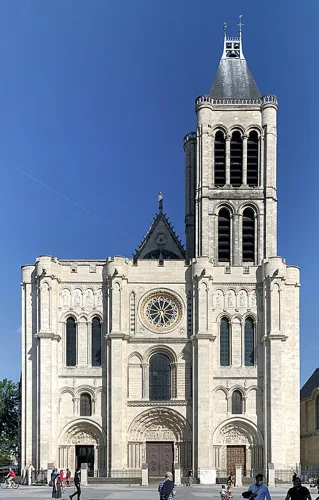
The Basilica of Saint-Denis, just north of the Paris boundary, is where Gothic architecture began: Abbot Suger's rebuilt choir of the 1140s brought together the pointed arch, the rib vault and large stained glass for the first time. It is also the burial church of the French monarchy, with around 70 royal tombs and effigies. The nave is free to enter; the tomb field in the transept and ambulatory is ticketed. Ninety minutes is enough.
Open in the planner →Getting there
Take Métro 13 to Basilique de Saint-Denis, roughly 25 minutes from Châtelet; make sure you board a train for the Saint-Denis-Universite branch rather than the Asnières branch, as line 13 splits. The station exit is almost at the west front, a walk of two or three minutes across the square. RER D to Saint-Denis station is an alternative but leaves a longer walk through the town centre. Tram T1 and T8 also stop nearby if you are coming across the northern suburbs.
What you see
The west front comes first, with its carved portals and the stump where the north tower was dismantled in the nineteenth century. Inside, walk up the nave to see the point of the building: the choir and ambulatory at the east end, where slim columns and a ring of chapels dissolve the wall into coloured glass. The tombs are the second half of the visit, a crowded gallery of effigies from the twelfth century onwards, including the kneeling Renaissance monuments to Louis XII and François I, and the recumbent figures of Henri II and Catherine de Médicis. The crypt below holds the Bourbon vault and the archaeological remains of the earlier churches.
What to pair it with
The Stade de France is a short walk away if you want a stadium tour. The Musée d'Art et d'Histoire Paul Éluard in the old Carmelite convent is ten minutes on foot, and the Saint-Denis market near the station is worth timing your visit around. Otherwise combine it with Montmartre, which is back down line 13 towards the centre.
When to go
Weekday mornings are calm, and the ambulatory glass reads best with the sun round to the east and south. Sunday mornings are given to services, so the tombs are less accessible. The market days bring the surrounding square alive and are the better time if you want the town as well as the church. Check opening before you go, since the ticketed part has shorter hours than the nave.
What is hard about it
Saint-Denis has a reputation that puts some visitors off, and the area around the station is busy and unpolished rather than picturesque; ordinary city caution is enough. The basilica has been heavily restored, some of the glass in the choir is nineteenth-century replacement, and the tombs were ransacked during the Revolution, so the effigies are survivors reassembled rather than an intact collection. The ticketed area can feel crowded with school groups. Those expecting Notre-Dame's scale will find this a smaller, plainer building.
Common questions
How long do you need at Saint-Denis?
About 90 minutes for the nave, the tombs and the crypt. An hour if you only want the architecture.
Do you have to pay to go in?
The nave is free as a working parish church. The royal tombs, the ambulatory and the crypt are a ticketed visit, and booking is normally not needed.
How far is it from the Métro station?
Two or three minutes. Basilique de Saint-Denis on line 13 comes out effectively on the church square.
More of the same kind
- Notre-Dame de ParisThe Gothic cathedral on the Île de la Cité, reopened after the 2019 fire
- Sainte-ChapelleFifteen windows of thirteenth-century glass in a single upper room
- Sacré-Cœur, ParisThe white basilica on the butte, and the best free view in the city
- PanthéonNeoclassical mausoleum of the Republic's great, with Foucault's pendulum