Square du Vert-Galant
The willow-shaded prow at the western tip of the island
- Area Île de la Cité
- Type Park
- Time needed 25m
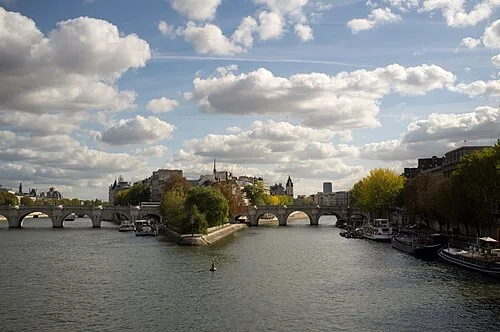
The Square du Vert-Galant is the small triangular garden at the western tip of the Île de la Cité, below the level of the Pont Neuf. It takes its name from a nickname for Henri IV, whose equestrian statue stands on the bridge above. It is a bench, a weeping willow and the point where the Seine splits around the island, and twenty-five minutes is about right.
Open in the planner →Getting there
Pont Neuf on Métro line 7 is two minutes away, at the Right Bank end of the bridge. Cité on line 4 and Châtelet, with lines 1, 4, 7, 11 and 14 and RER A, B and D, are each five to ten minutes on foot. From Châtelet it is a walk rather than a ride, about eight minutes. The garden is reached by a staircase down from the middle of the Pont Neuf, beside the Henri IV statue, and there is no step-free way in.
What you see
The stair brings you out among plane trees onto a narrowing paved point. The willow at the far tip is the photographed one, leaning over the water. From the end you look upstream at the two arms of the river rejoining, with the Louvre and the Pont des Arts to the left, the Institut de France and the Left Bank quais to the right, and barges passing close enough to rock the moored boats. Behind you is the brick and stone of the Place Dauphine, and the underside of the Pont Neuf arches frames the view back towards Châtelet. People fish, eat sandwiches and sit along the stone edge; it is a sitting-down place and has nothing else in it.
What to pair it with
The Pont Neuf and the Place Dauphine are directly above. The Sainte-Chapelle and the Conciergerie are five minutes east along the island, and the Pont des Arts and the Louvre a similar walk west.
When to go
Late afternoon and the hour before sunset are the reason to come, with the light running straight up the river. It is quiet on winter weekdays and full on summer evenings, when it is a drinking spot. The square closes at night and the gates are locked, with earlier closing in winter, and it shuts entirely when the Seine is high enough to flood the point, which happens most winters.
What is hard about it
There is no shade on the point itself once past the trees, no toilets and nothing to buy. Summer evenings leave litter and broken glass, and the benches are taken by late afternoon. Access is by steps only, so it is out of reach with a wheelchair or a heavy pushchair, and the garden is simply closed when the river rises. Do not expect more than a view and a bench.
Common questions
How long do you need at the Square du Vert-Galant?
Twenty-five minutes, which is a slow walk to the tip and a sit on the wall. There is nothing to visit.
How do you get down to it?
A staircase leads down from the centre of the Pont Neuf by the Henri IV statue. There is no ramp or lift.
Is it free?
Yes, it is a public garden with no charge, though it closes at night and during Seine flooding.
Nearby
- Notre-Dame de ParisThe Gothic cathedral on the Île de la Cité, reopened after the 2019 fire
- Sainte-ChapelleFifteen windows of thirteenth-century glass in a single upper room
- Pont NeufDespite the name, the oldest standing bridge over the Seine
- ConciergerieThe medieval royal palace that became the Revolution's prison
- Pont des ArtsThe wooden footbridge between the Louvre and the Institut de France
More of the same kind
- Jardin du LuxembourgFormal gardens round the Senate, with green chairs and a toy-boat pond
- Tuileries GardenThe formal garden between the Louvre and the Concorde
- Parc de la VilletteThe largest park in Paris, scattered with bright red follies
- Bois de BoulogneThe city's western wood, with lakes, gardens and racecourses
Part of these routes
- The island and the LouvreThe oldest part of Paris and the largest museum in it, with the river between them.
- Along the SeineBridges, quays and the two islands, walked end to end.
- Paris in five daysA fuller first visit: the island, the Louvre, the Left Bank, Montmartre and Versailles.
- Paris at lengthEverything the other routes cover, spread over unhurried days with nothing rushed.