Tuileries Garden
The formal garden between the Louvre and the Concorde
- Area 1st arrondissement
- Type Park
- Time needed 45m
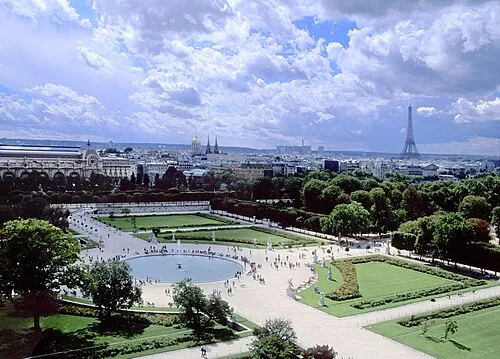
The Jardin des Tuileries fills the space between the Louvre and Place de la Concorde, about a kilometre long on the right bank of the Seine. Catherine de Medici began it in 1564 and Andre Le Notre redesigned it in the 1660s into the formal French layout you walk today; the palace it belonged to was burned in 1871 and never rebuilt, which is why the eastern end opens straight onto the Louvre. It is free to enter and it is the main pedestrian route between the two. Two museums stand at its Concorde end.
Open in the planner →Getting there
Tuileries on Métro line 1 puts you at the middle of the north side, about 5 minutes from Châtelet. Concorde (lines 1, 8 and 12) is at the western gate and Palais Royal–Musée du Louvre (lines 1 and 7) at the eastern one, so you can enter at either end and walk through. From the left bank, the footbridge from the Musée d'Orsay side brings you in over the river by the Passerelle Leopold-Sedar-Senghor. Walking the full length takes about 20 minutes.
What you see
From the Louvre end you pass through the Arc de Triomphe du Carrousel, a smaller pink-marble arch, then into the Jardin du Carrousel where a group of Maillol bronzes stands among the hedges. The central alley runs dead straight west, and standing on it with your back to the Louvre you are looking along the historic axis through the Concorde obelisk and the Arc de Triomphe to La Defense beyond. Two large round basins punctuate the walk, the Grand Bassin Rond in the middle and the octagonal Grand Bassin Octogonal near the Concorde, both ringed with the same green chairs you get at the Luxembourg. The garden holds a substantial open-air sculpture collection: nineteenth-century marble groups along the terraces and twentieth-century pieces, including works by Rodin, Giacometti and Dubuffet, set among the clipped yew and chestnut. At the far end the two surviving pavilions of the old palace terrace face each other across the gate: the Jeu de Paume, now a photography gallery, on the north, and the Orangerie with Monet's Water Lilies on the south.
What to pair it with
The Louvre is at one end and Place de la Concorde at the other. The Musée de l'Orangerie is inside the garden's south-west corner, and the Musée d'Orsay is a ten-minute walk across the footbridge.
When to go
Early morning gives you the empty central alley and long light down the axis, which is the best thing here. Midday in summer is crowded and the gravel throws heat with very little shade off the tree-lined side alleys. Spring brings the parterre planting; autumn the chestnut colour. The garden closes at dusk, which is early in winter. A funfair occupies part of the Concorde end in summer in most years and a Christmas market does something similar in winter, which changes the character of that half considerably.
What is hard about it
It is mostly gravel and open sky, so it is hot and glaring in high summer and bleak in a wet winter; the shade is confined to the side alleys. Lawns are fenced and not for sitting on. The seasonal funfair or market at the western end brings noise, fencing and crowds to the stretch nearest the Concorde for weeks at a time. Toilets are limited and usually have a queue. As a garden it is architecture rather than horticulture, and visitors who come expecting flowers find clipped hedges and gravel instead.
Common questions
How long do you need at the Tuileries Garden?
About 45 minutes to walk the length with stops at the basins and some of the sculpture. Less if you are simply crossing between the Louvre and the Concorde.
Is the Tuileries free?
Yes, the garden is free to enter and open daily until dusk. The Orangerie and the Jeu de Paume at the western end are ticketed.
Where was the Tuileries Palace?
It stood across the eastern end, closing off what is now the open view to the Louvre. It burned during the Commune in 1871 and the ruins were cleared, leaving only the two end pavilions at the Concorde side.
Nearby
- LouvreThe largest art museum on earth, in a palace, behind a glass pyramid
- Place de la ConcordeThe largest square in Paris, with an Egyptian obelisk at its centre
- Palais-RoyalArcaded gardens behind the Louvre, with Buren's striped columns
More of the same kind
- Jardin du LuxembourgFormal gardens round the Senate, with green chairs and a toy-boat pond
- Parc de la VilletteThe largest park in Paris, scattered with bright red follies
- Bois de BoulogneThe city's western wood, with lakes, gardens and racecourses
- Coulée verte René-DumontA planted walk along a disused viaduct, the first of its kind
Part of these routes
- Gardens and squaresFour very different pieces of green, from formal parterre to English folly.
- Paris in three daysThe short list, ordered so each day holds together and nothing is crossed twice.
- Paris in five daysA fuller first visit: the island, the Louvre, the Left Bank, Montmartre and Versailles.
- Paris at lengthEverything the other routes cover, spread over unhurried days with nothing rushed.