Louvre
The largest art museum on earth, in a palace, behind a glass pyramid
- Area 1st arrondissement
- Type Museum
- Time needed 3h 30m
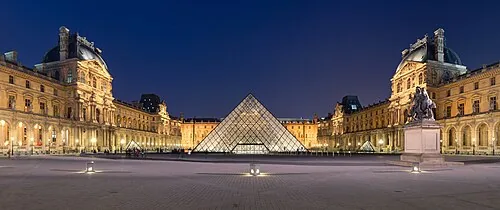
The Louvre is the largest art museum in the world, housed in what was a royal palace until the court left for Versailles, and opened as a public museum in 1793. The collection runs from Mesopotamian steles to the mid-nineteenth century across three wings — Denon, Sully and Richelieu — around the glass pyramid Pei added in 1989. Nobody sees it all, and the people who enjoy it most go in with a short list.
Open in the planner →Getting there
Palais Royal-Musee du Louvre on Metro lines 1 and 7 is the station to use: it connects underground to the Carrousel du Louvre shopping concourse and the museum entrance there, which means no outdoor queue. It is two stops and about five minutes from Chatelet on line 1. Louvre-Rivoli on line 1 is one stop further east and leaves you a five minute walk along the Rue de Rivoli to the pyramid courtyard. The Tuileries stop on line 1 works if you want to arrive through the gardens from the west.
What you see
From under the pyramid you choose a wing, and the sensible order is to take the famous things first before the galleries fill. Denon, up the stairs, holds the Winged Victory of Samothrace on its landing, the long Italian painting gallery, and at the end of it the Mona Lisa in its own large room behind glass and a managed crowd. Still in Denon, the Italian sculpture rooms have Michelangelo's Slaves, and the big French nineteenth-century canvases include the Raft of the Medusa and the Coronation of Napoleon in the adjoining rooms. Sully, around the oldest part of the palace, has the Venus de Milo, the Egyptian collection including the Seated Scribe, and in the basement the excavated medieval foundations of the original fortress, which almost nobody walks through and which explain the whole building. Richelieu is the quietest wing: Mesopotamian and Persian antiquities, the Napoleon III apartments kept as furnished rooms, and the two glazed courtyards of French sculpture where you can sit down. The painted ceilings of the Galerie d'Apollon are worth the detour on the way back.
What to pair it with
The Tuileries garden runs west from the door and the Musee d'Orsay is a 15 minute walk across the Pont Royal. Sainte-Chapelle and the Ile de la Cite are 20 minutes east along the river. The Palais Garnier is a 15 minute walk north.
When to go
Go at opening or in the last two hours; the middle of the day is dense in every season. The museum closes one day a week, and the day after a closed day is predictably busier. Late openings on a couple of evenings a week are the best time in the building — the same rooms with a fraction of the people. Winter weekday mornings are the genuine quiet period. Avoid the free-entry evenings if crowds bother you, since those are the busiest hours of the week.
What is hard about it
The scale defeats people. Four hours in and you are still walking, the rooms blur, and the exit is a long way from wherever you have ended up. Timed online booking is normally needed even with a Paris Museum Pass, and arriving without a slot in season may mean not getting in at all. The Mona Lisa is a disappointment to most visitors: it is small, behind glass, at the far end of a packed room, and you get perhaps thirty seconds at a distance. Signage is better than it was but still confusing where the wings meet, and galleries close at short notice for staffing with no warning on the website. Food inside is poor value. There is a great deal of stair and polished floor; the lifts exist but are awkward to find.
Common questions
How long do you need at the Louvre?
Three to four hours is a realistic first visit covering one or two wings. A full day only works if you break it with a long sit-down.
Which entrance has the shortest queue?
The Carrousel du Louvre entrance, reached underground from the Palais Royal-Musee du Louvre Metro station, is normally faster than the pyramid in the open courtyard.
Can you see the main works in two hours?
Yes, if you go straight up into Denon for the Winged Victory, the Italian gallery and the Mona Lisa, then cut across to the Venus de Milo in Sully.
Nearby
- Place de la ConcordeThe largest square in Paris, with an Egyptian obelisk at its centre
- Tuileries GardenThe formal garden between the Louvre and the Concorde
- Palais-RoyalArcaded gardens behind the Louvre, with Buren's striped columns
More of the same kind
- Musée d'OrsayImpressionism in a converted railway station, under the great clock
- Centre PompidouModern art behind the inside-out pipes of Rogers and Piano
- Musée RodinThe Thinker and the Gates of Hell in a mansion with a sculpture garden
- Musée de l'OrangerieMonet's Water Lilies in two oval rooms built for them
Part of these routes
- The island and the LouvreThe oldest part of Paris and the largest museum in it, with the river between them.
- Paris in three daysThe short list, ordered so each day holds together and nothing is crossed twice.
- Paris in five daysA fuller first visit: the island, the Louvre, the Left Bank, Montmartre and Versailles.
- Paris at lengthEverything the other routes cover, spread over unhurried days with nothing rushed.