Musée Rodin
The Thinker and the Gates of Hell in a mansion with a sculpture garden
- Area 7th arrondissement
- Type Museum
- Time needed 1h 30m
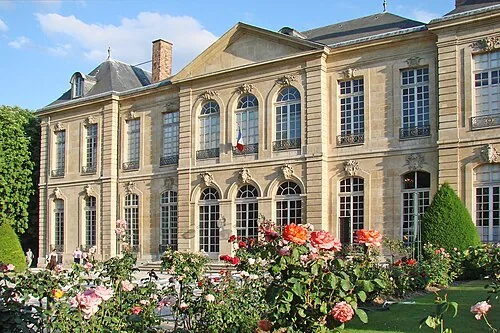
The Musée Rodin occupies the Hôtel Biron, an early eighteenth-century mansion in the 7th arrondissement where Auguste Rodin worked in his last years, and it opened as a museum in 1919 on the collection he left to the French state. It holds the plasters, marbles and bronzes of most of his major works, including The Thinker, The Kiss, The Burghers of Calais and the unfinished Gates of Hell. Roughly half the visit is outdoors, in a three-hectare sculpture garden behind the house. There is also a room of works by Camille Claudel.
Open in the planner →Getting there
Varenne on Métro line 13 is the closest station, about two minutes from the entrance on the rue de Varenne, and takes roughly 12 minutes from Châtelet with a change at Montparnasse–Bienvenue or Saint-Lazare. Invalides, served by Métro lines 8 and 13 and RER C, is about a 7 minute walk. Saint-Francois-Xavier on line 13 is a similar distance from the garden side. The museum is a straightforward 10 minute walk from Les Invalides and about 15 from the Musée d'Orsay.
What you see
Buy the ticket and go into the garden first if the weather allows, because that is where the big bronzes are and where they are meant to be seen. To the right of the house The Thinker sits on a plinth in a hedged enclosure; further along, the full-size Gates of Hell stands against a backdrop of trees, and it rewards several minutes of close looking because almost every figure Rodin made later appears somewhere in it. The Burghers of Calais group is set low on the lawn so you can walk among them, and the Balzac and the Monument to Victor Hugo are nearby. At the far end a long ornamental pond closes the garden, with a rose terrace along one side. Inside the house the rooms run chronologically through the ground and first floors: the early studies and portraits, The Kiss in marble, the many studies of hands and partial figures, the plaster and bronze versions of Balzac in his dressing gown, and the fragmentary works that show how he assembled figures from parts. One room is given to Camille Claudel, including The Waltz and The Age of Maturity. The chapel in the grounds holds temporary exhibitions.
What to pair it with
Les Invalides and the army museum are ten minutes away on foot. The Musée d'Orsay is fifteen minutes north along the rue de Bellechasse, and the Eiffel Tower about twenty-five minutes west.
When to go
Opening time on a weekday is quietest and the garden is at its best before the coach groups arrive late morning. Closed one day a week, usually Monday, so check before you go. Late spring and early summer give you the roses and full foliage behind the bronzes; in winter the garden is bare and some of the outdoor seating is put away, which shortens the visit considerably. Rain hurts this museum more than most, since the garden is half the point. Late afternoon light falls well on The Thinker and the Gates.
What is hard about it
There is almost always a queue at the ticket desk even with timed entry, so booking a slot online is sensible. The indoor rooms are small and get congested at the famous pieces, and in bad weather everyone is inside at once. A garden-only ticket exists at a lower rate but means missing The Kiss and the Claudel room. The house has stairs, and although there is lift access the historic building is not fully easy to move around. Visitors expecting a large collection of finished marbles can be surprised by how much of it is plaster studies and fragments, which is the point of the place but not what everyone comes for.
Common questions
How long do you need at the Musée Rodin?
About 90 minutes split between the garden and the house. Two hours or more if you read the labels or sit in the garden.
Can you see The Thinker without buying a full ticket?
Yes. The Thinker, the Gates of Hell and the Burghers are all in the garden, which has a cheaper garden-only admission, though the house and the Claudel room are then closed to you.
Is it worth it in bad weather?
Less so, since the garden is half the visit and the indoor galleries are modest in size. If it is raining hard, the Musée d'Orsay nearby is the better use of the time.
Nearby
- Musée d'OrsayImpressionism in a converted railway station, under the great clock
- Les InvalidesThe gilded dome over Napoleon's tomb, and the army museum beneath
- Pont Alexandre IIIThe most ornate bridge in Paris, gilded at all four corners
- Musée du Quai Branly - Jacques ChiracArt of Africa, Asia, Oceania and the Americas behind a living wall
- Rue ClerA short market street near the Invalides, cobbled and pedestrian
More of the same kind
- LouvreThe largest art museum on earth, in a palace, behind a glass pyramid
- Centre PompidouModern art behind the inside-out pipes of Rogers and Piano
- Musée de l'OrangerieMonet's Water Lilies in two oval rooms built for them
- Musée PicassoThe largest Picasso collection anywhere, in a Marais mansion
Part of these routes
- The Left BankImpressionists in a station, Rodin's garden, and the streets of Saint-Germain.
- Paris in three daysThe short list, ordered so each day holds together and nothing is crossed twice.
- Paris in five daysA fuller first visit: the island, the Louvre, the Left Bank, Montmartre and Versailles.
- Paris at lengthEverything the other routes cover, spread over unhurried days with nothing rushed.