Pont Alexandre III
The most ornate bridge in Paris, gilded at all four corners
- Area 7th arrondissement
- Type Landmark
- Time needed 20m
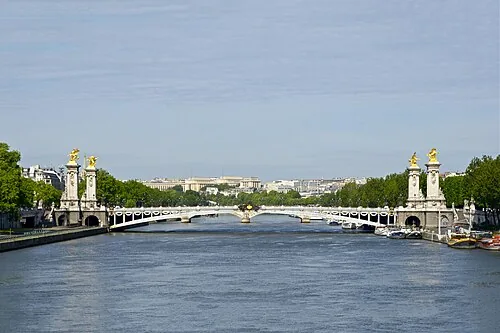
Pont Alexandre III is the most heavily decorated bridge in Paris, built for the 1900 Exposition Universelle and named after the Russian tsar whose son laid the foundation stone, as a monument to the Franco-Russian alliance. It crosses the Seine in a single steel arch, deliberately kept low and flat so it would not block the view between the Invalides and the Grand Palais. Four stone pylons at the corners carry gilded winged figures, and the parapet runs with lamps, cherubs and nymphs. It takes about five minutes to walk across and there is nothing to enter.
Open in the planner →Getting there
Invalides station on Métro lines 8 and 13 and RER C is at the south end, about 15 minutes from Châtelet. Champs-Élysées–Clemenceau on lines 1 and 13 is a 5 minute walk from the north end, and about 10 minutes from Châtelet on line 1. The Batobus and the river cruise boats stop nearby on the right bank. On foot the bridge is 10 minutes down the esplanade from Les Invalides, or about the same from the lower Champs-Élysées past the Grand Palais.
What you see
Walk it slowly in both directions, because the two views are different and both are the reason to come. Looking south you have the esplanade running straight to the gilded dome of Les Invalides; looking north, the glass roof and sculpture of the Grand Palais with the Petit Palais beside it. Upstream the Eiffel Tower stands clear over the river on the left bank, and this is the best Eiffel Tower view available from any Paris bridge. On the deck itself, look at the four tall pylons with their gilded Fames on horseback, two at each end, and then at the parapet work: bronze lamps on scrolled standards, winged cherubs, and large groups of nymphs in relief on each side of the arch, one pair representing France and one Russia. The low single span is worth noticing from the quay below, where you can see how shallow the arch is. Steps lead down to the quayside at the corners, and the walk along the lower quay under the bridge is pleasant.
What to pair it with
Les Invalides is ten minutes south down the esplanade. The Grand Palais and Petit Palais are at the north end, and the lower Champs-Élysées begins just beyond them.
When to go
Blue hour, the half hour after sunset, is the time to be here: the lamps and the gilding come on and the Invalides dome is floodlit at the end of the esplanade. Early morning gives you the bridge nearly empty with soft light on the gilt. Midday sun flattens it. It is busiest in the evening and in summer, when photographers and wedding parties occupy the best spots on the parapet. The Eiffel Tower's light display on the hour after dark is visible from the deck.
What is hard about it
It is a working road bridge with four lanes of traffic, so the pavements are narrow in places and it is noisy; the view is good but the standing about is not comfortable. There is nothing to visit, no interior and no viewing platform, so this is a 15 to 20 minute stop. Photographers compete for the few spots where the parapet frames the Eiffel Tower, and in the evening you will be waiting your turn. The bridge is exposed to wind off the river and there is no shelter at all. Parts of the sculpture and gilding are often under restoration netting, and the quayside steps can be closed when the Seine is high.
Common questions
How long do you need at Pont Alexandre III?
Fifteen to twenty minutes to cross it, look at the pylons and the parapet work, and take in both views. It is a stop on a walk rather than a destination.
Is this the best bridge for photographing the Eiffel Tower?
It gives the clearest unobstructed view of the tower from a Paris bridge, taken from the upstream parapet. Pont de Bir-Hakeim and the Trocadero side are the other usual choices and give a closer, framed shot.
How do you get down to the river level?
Staircases at the corners lead to the lower quays on both banks, and you can walk under the arch. They are sometimes shut during high water or works.
Nearby
- Musée d'OrsayImpressionism in a converted railway station, under the great clock
- Musée RodinThe Thinker and the Gates of Hell in a mansion with a sculpture garden
- Les InvalidesThe gilded dome over Napoleon's tomb, and the army museum beneath
- Musée du Quai Branly - Jacques ChiracArt of Africa, Asia, Oceania and the Americas behind a living wall
- Rue ClerA short market street near the Invalides, cobbled and pedestrian
More of the same kind
- Eiffel TowerGustave Eiffel's 330-metre iron tower, the one unmistakable thing on the skyline
- Arc de TriompheNapoleon's arch at the top of the Champs-Élysées, with a roof terrace
- Palais GarnierGarnier's opera house, all marble staircase, gold and Chagall ceiling
- Place de la ConcordeThe largest square in Paris, with an Egyptian obelisk at its centre