Palais Garnier
Garnier's opera house, all marble staircase, gold and Chagall ceiling
- Area Opéra
- Type Landmark
- Time needed 1h 15m
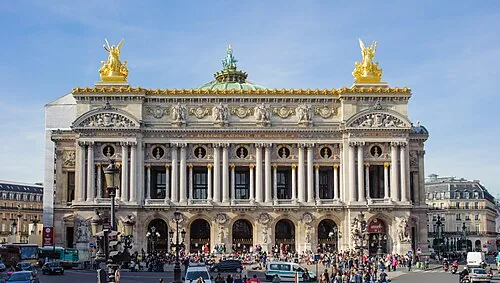
The Palais Garnier opened in 1875 as the Paris opera house, designed by Charles Garnier after he won an open competition as an unknown 35-year-old. It is the most elaborate public interior in the city — marble staircase, mirrored grand foyer, gilt and velvet auditorium — and Chagall painted the ceiling over the house in 1964. Most of the opera company's performances have moved to the Opera Bastille, so the Garnier is now visited by day as a building as much as used by night.
Open in the planner →Getting there
Opera is the station at the door, served by Metro lines 3, 7 and 8, about seven minutes from Chatelet on line 7. Auber on RER A and Haussmann-Saint-Lazare on RER E are both two minutes away underground, which makes it the easiest major sight in Paris to reach from the suburbs or from Charles de Gaulle via RER B and a change. Chaussee d'Antin-La Fayette on lines 7 and 9 is three minutes behind the building. The visitor entrance is not the main front steps but round the side, which catches people out.
What you see
The grand staircase is the first room and the reason the building exists: a double flight of white, green and red marble rising through a thirty-metre well, built so that an audience in evening dress could watch each other arrive. Off it, the Grand Foyer runs the width of the front — a long gilded gallery with mirrors, chandeliers and a painted vaulted ceiling, modelled on a palace gallery and intended for the interval promenade. The Salon du Glacier at one end has a circular painted ceiling of dancers. Access to the auditorium itself is from a box on one of the upper levels and is not guaranteed on any given visit, since rehearsals close it; when you do get in, the house is a deep red and gold horseshoe of five tiers with a seven-tonne bronze chandelier and the Chagall ceiling above it, a ring of bright colour that sat oddly in a nineteenth-century room when new and still does. The rotunda, the subscribers' pavilion, the library and museum with set models and scores, and the long views down over the Avenue de l'Opera from the loggia complete the circuit. The underground lake of the Phantom story is real in the sense that there is a water reservoir under the stage, but it is not open and never has been.
What to pair it with
The Galeries Lafayette, whose rooftop terrace gives a free view of the building and the city, is three minutes north. The Louvre is a 15 minute walk down the Avenue de l'Opera. The Place Vendome and the Tuileries are ten minutes south.
When to go
Weekday mornings are the best chance of a quiet building and of the auditorium being open before rehearsals start; afternoons are busier and the house is more often shut. Daytime visiting is restricted or cancelled when there is a matinee or a technical rehearsal, so check the calendar for the day you want. Guided tours run on a fixed schedule and give access to rooms the self-guided route misses. The staircase and foyer photograph best in late morning light through the front windows.
What is hard about it
The auditorium is the thing people come for and it is the thing most likely to be closed; a notice at the door is how you find out, there is no advance warning, and no reduction for it. Even when open you are let into a single box for a few minutes with a crowd behind you. The self-guided route is unexplained unless you take an audio guide or a tour, so a lot of visitors walk through gilded rooms with no idea what they are. Timed tickets are normally needed and the building closes to visitors on performance days and for private events. There are stairs everywhere and the lift provision is limited. Attending an actual performance is the best way to see the house, but the cheap seats have genuinely restricted views of the stage.
Common questions
How long do you need at the Palais Garnier?
About 75 minutes self-guided, or an hour and a half with a guided tour. The library and museum add half an hour.
Can you see the auditorium and the Chagall ceiling?
Usually, but not reliably: the house closes for rehearsals and performances with no notice, and visiting is from a box rather than the stalls. Morning visits have the better odds.
Is it better to visit by day or see a performance?
A performance shows you the building as intended and is worth the ticket, but you will not see the grand foyer and staircase properly in the crush. Doing both is the honest answer.
Nearby
More of the same kind
- Eiffel TowerGustave Eiffel's 330-metre iron tower, the one unmistakable thing on the skyline
- Arc de TriompheNapoleon's arch at the top of the Champs-Élysées, with a roof terrace
- Place de la ConcordeThe largest square in Paris, with an Egyptian obelisk at its centre
- Les InvalidesThe gilded dome over Napoleon's tomb, and the army museum beneath