Centre Pompidou
Modern art behind the inside-out pipes of Rogers and Piano
- Area Beaubourg
- Type Museum
- Time needed 2h
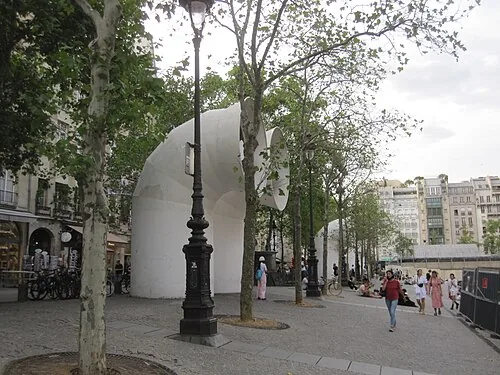
The Centre Pompidou opened in 1977 to a design by Renzo Piano and Richard Rogers that put the structure, ducts, lifts and escalators on the outside so the interior could be clear floors. Inside is the Musee National d'Art Moderne, the largest modern art collection in Europe, along with a public library, a cinema and a music research institute. It stands in the Beaubourg quarter just north of the Marais, on a sloping open square.
Open in the planner →Getting there
Rambuteau on Metro line 11 is the closest station, a two minute walk, and about four minutes from Chatelet. Hotel de Ville on lines 1 and 11 is a five minute walk south. Chatelet-Les Halles, the big RER interchange, is a seven or eight minute walk west through the Les Halles development, which is the route to use if you are coming in on RER A, B or D. The square in front slopes down to the entrance and the building is unmissable once you are in the quarter.
What you see
The external escalator in its glass tube up the west face is part of the visit and the reason to go to the top floor first: the view east and south over the Marais roofs, Notre-Dame, the Pantheon dome and the Montmartre skyline is one of the best in central Paris and comes with the museum ticket. The permanent collection sits on two floors and is hung chronologically: the earlier one takes you from Matisse, Picasso, Braque and the Cubists through Kandinsky, Mondrian, Dada and Surrealism, with a large room of Brancusi and Duchamp material; the later floor covers post-1960 work, Pop, Arte Povera, Nouveau Realisme and contemporary installation, which rotates more often. Big temporary exhibitions occupy the top level and are usually the reason the queues exist. Outside, the Stravinsky fountain by Tinguely and Niki de Saint Phalle, with its moving coloured machinery, is round the south side next to the IRCAM building, and Brancusi's reconstructed studio is a small free pavilion on the north edge of the square. Note that the centre has entered a long closure for major renovation; check what is open and where the collection is showing before you plan a visit around it.
What to pair it with
The Marais, the Place des Vosges and the Picasso museum are 10 to 15 minutes east. Notre-Dame and the Ile de la Cite are a ten minute walk south. Les Halles and the Saint-Eustache church are five minutes west.
When to go
Late afternoon gives the best light from the top-floor terrace looking south-west, and the building is open late on most days it opens, later than other Paris museums, which makes an evening visit practical. It closes one day a week. Weekday mornings are quiet in the permanent collection; weekends and school holidays fill the escalators. Temporary exhibition openings and the last weeks of a popular show are the worst times.
What is hard about it
The renovation closure is the first thing to check — the programme has been announced and parts of the building and the collection will be unavailable or relocated for an extended period, and published plans have shifted more than once. Beyond that: the escalator view is only included with a museum or exhibition ticket, not as a separate cheap climb as it once was, which annoys people who come for the view. The permanent collection is enormous and the later floor is divisive; visitors who like the Impressionists often do not like this building's contents. The square outside attracts rough sleeping and aggressive begging, and the surrounding streets are grubby. The architecture has aged and the interior reads as dated rather than radical. Timed booking is normally needed for the big exhibitions.
Common questions
How long do you need at the Centre Pompidou?
Two hours covers one floor of the permanent collection and the top-floor view. A major temporary exhibition on top of that makes it three or four.
Is the Centre Pompidou open?
A long renovation closure has been announced, so check the centre's own site for current status and for where parts of the collection are being shown in the meantime.
Can you ride the escalator just for the view?
Not on a free basis. Access to the upper levels and the terrace normally requires a museum or exhibition ticket.
More of the same kind
- LouvreThe largest art museum on earth, in a palace, behind a glass pyramid
- Musée d'OrsayImpressionism in a converted railway station, under the great clock
- Musée RodinThe Thinker and the Gates of Hell in a mansion with a sculpture garden
- Musée de l'OrangerieMonet's Water Lilies in two oval rooms built for them
Part of these routes
- Museums beyond the LouvreFour collections that would each be the main museum of a smaller city.
- Paris from aboveFour high places, ordered so the light and the queues fall the right way.
- Paris in three daysThe short list, ordered so each day holds together and nothing is crossed twice.
- Paris in five daysA fuller first visit: the island, the Louvre, the Left Bank, Montmartre and Versailles.
- Paris at lengthEverything the other routes cover, spread over unhurried days with nothing rushed.