Palais-Royal
Arcaded gardens behind the Louvre, with Buren's striped columns
- Area 1st arrondissement
- Type Landmark
- Time needed 45m
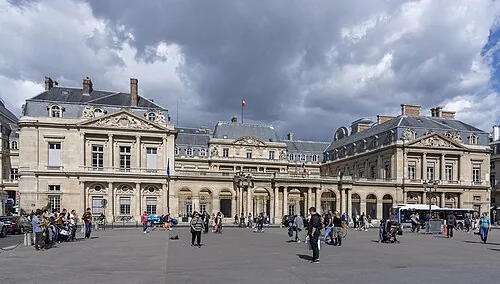
The Palais-Royal stands immediately north of the Louvre: a palace built for Cardinal Richelieu in the 1630s, later a royal residence, and from 1986 the setting for Daniel Buren's Les Deux Plateaux, the field of 260 truncated black-and-white striped columns in the main courtyard. Behind it is a long formal garden enclosed by arcades of shops, which was one of the first commercial galleries in Europe and a focus of pre-Revolutionary political life. The palace buildings house the Conseil d'État and the Ministry of Culture and are closed to visitors, but the courtyards and garden are free and open daily.
Open in the planner →Getting there
Palais-Royal - Musée du Louvre, on Métro lines 1 and 7, is at the south-west corner of the complex; from Chatelet it is two minutes on line 1. Pyramides on lines 7 and 14 and Bourse on line 3 are each about five minutes' walk. The Cour d'honneur with the columns is entered from the place Colette by the Métro exit, and the garden lies through the arcade beyond it.
What you see
Come in from the place Colette past Jean-Michel Othoniel's beaded glass Métro canopy, the Kiosque des noctambules, and into the Cour d'honneur, where Buren's columns rise from a grid at different heights out of the paving, with two sunken channels of running water beneath grates on either side; people sit and climb on them, and the low ones are chest height while the tall ones are well above head height. Through the arch is the Galerie d'Orléans, with Pol Bury's two basins of polished steel spheres turning in the water, and then the Jardin du Palais-Royal: a double avenue of clipped limes, a circular fountain at the centre, rose beds down the sides and benches that are among the quietest in central Paris. The surrounding arcades — the galeries de Valois, de Montpensier and de Beaujolais — hold old-fashioned specialist shops: military medals, antique toy soldiers, rare stamps, vintage couture, a famous perfumer, and the long-established restaurant at the north end. Look up for the plaques, including the one marking Colette's apartment overlooking the garden.
What to pair it with
The Louvre is across the rue de Rivoli, and the Comédie-Française is on the place Colette by the entrance. The covered passages of the 2nd arrondissement, the Galerie Vivienne and the Passage Choiseul, begin a few minutes north, and the Bourse de Commerce and Les Halles are ten minutes west.
When to go
Early morning is nearly empty and the best time to photograph the columns without people on them; by midday the courtyard is a playground and the garden benches are taken by office workers. Spring, when the limes come into leaf and the roses start, and October, when the garden goes copper, are the best seasons. The gates close at dusk and earlier in winter; the courtyard with the columns stays accessible longer than the garden.
What is hard about it
There is no interior to visit: the palace itself is government offices, and the only inside you get is the arcade shops and the theatre. The columns are divisive — they were strongly opposed when installed and some visitors still find them an intrusion on a seventeenth-century courtyard — and they have been grubby and in need of cleaning for long stretches, with the water channels sometimes drained and fenced. The courtyard is a hard, shadeless space in summer. The arcade shops are expensive and several sit empty or keep short hours, which makes the galleries feel deader than their reputation. Toilets are limited.
Common questions
How long do you need at the Palais-Royal?
About 45 minutes for the columns, the arcades and a turn round the garden. Longer if you sit, or browse the shops.
Is the Palais-Royal free to visit?
Yes. The courtyards, the Buren columns and the garden are free and open daily; the palace buildings themselves are closed to the public.
What are the striped columns?
Les Deux Plateaux, a 1986 installation by Daniel Buren: 260 black-and-white striped columns of varying heights set in the Cour d'honneur. You are allowed to walk among and sit on them.
Nearby
- LouvreThe largest art museum on earth, in a palace, behind a glass pyramid
- Place de la ConcordeThe largest square in Paris, with an Egyptian obelisk at its centre
- Tuileries GardenThe formal garden between the Louvre and the Concorde
More of the same kind
- Eiffel TowerGustave Eiffel's 330-metre iron tower, the one unmistakable thing on the skyline
- Arc de TriompheNapoleon's arch at the top of the Champs-Élysées, with a roof terrace
- Palais GarnierGarnier's opera house, all marble staircase, gold and Chagall ceiling
- Les InvalidesThe gilded dome over Napoleon's tomb, and the army museum beneath