Coulée verte René-Dumont
A planted walk along a disused viaduct, the first of its kind
- Area 12th arrondissement
- Type Park
- Time needed 1h 15m
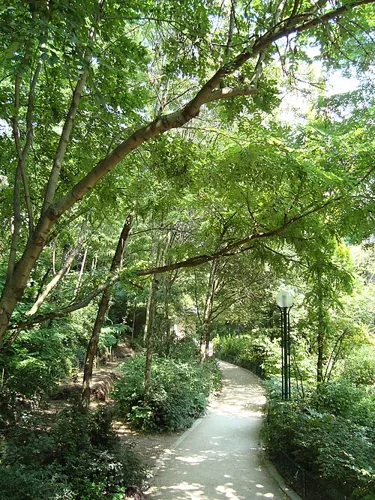
The Coulée verte René-Dumont is a planted walkway on the deck of a disused railway viaduct, running roughly 4.5 km east from near the Opéra Bastille to the Bois de Vincennes. The line closed in 1969 and the walk opened in 1993, the first of its kind anywhere and the model for New York's High Line. It is a public park with no ticket, though it closes at night like other Paris parks.
Open in the planner →Getting there
Metro 1, 5 and 8 to Bastille, then a five-minute walk east along avenue Daumesnil to the first stair up: from Châtelet that is about ten minutes on line 1. Metro 8 to Ledru-Rollin or Montgallet, and Metro 6 to Dugommier or Bel-Air, all give access further along. RER A and Metro 1 to Nation is close to the eastern half. Access points are frequent but they are mostly stairs; the lift situation varies, so if that matters start at the Bastille end where the arrangements are best.
What you see
The first and best stretch is the viaduct itself above avenue Daumesnil, about ten metres up, where the path runs between clipped hedges, pergolas of climbing roses, lavender, bamboo and pools of water, with the rooftops and balconies of 19th-century apartment blocks at eye level on both sides — you look into people's windows, and they look back. Beneath the arches is the Viaduc des Arts, a row of brick vaults converted into craft workshops and showrooms for furniture, instruments, textiles and restoration trades, worth walking back along at street level. Past the Jardin de Reuilly the walk comes down to ground, crosses a lawn on a footbridge, then continues through cuttings, tunnels and a long trench with high walls, which is cooler, greener and much less visited. The far end reaches the Bois de Vincennes near the Porte Dorée.
What to pair it with
Place de la Bastille is at the western end, the Canal Saint-Martin starts from the same square at its buried end, and the Bois de Vincennes and its chateau are at the far eastern end.
When to go
Morning on a weekday is the quietest, and spring, when the roses and wisteria are out on the viaduct pergolas, is the best season by some distance. Weekend late mornings bring joggers and families in numbers on the Bastille end. It closes at dusk and the closing time moves with the season, so check before a late-afternoon start in winter. Summer middays on the viaduct are hot and exposed.
What is hard about it
It is a long, linear walk and the quality tails off: the first kilometre on the viaduct is excellent, the middle is pleasant, and the eastern end through cuttings is for completists. Access is by stairs at most entrances, which rules it out for some; wheelchair and pushchair access exists but is limited to particular points. Cycling is not permitted on the viaduct section, so do not plan to ride it. There are few cafés or toilets along the route itself, the gates close at dusk, and sections are shut for maintenance from time to time.
Common questions
How long do you need at the Coulée verte?
An hour and a quarter walks the good western half and lets you come back down through the Viaduc des Arts. The full length to Vincennes takes well over two hours.
Do you need a ticket?
No. It is a free public park. It does close at night, with times that change by season.
Can you cycle it?
No, not the elevated viaduct section. Some ground-level stretches further east allow bikes, but treat it as a walk.
More of the same kind
- Jardin du LuxembourgFormal gardens round the Senate, with green chairs and a toy-boat pond
- Tuileries GardenThe formal garden between the Louvre and the Concorde
- Parc de la VilletteThe largest park in Paris, scattered with bright red follies
- Bois de BoulogneThe city's western wood, with lakes, gardens and racecourses