Parc de la Villette
The largest park in Paris, scattered with bright red follies
- Area La Villette
- Type Park
- Time needed 1h
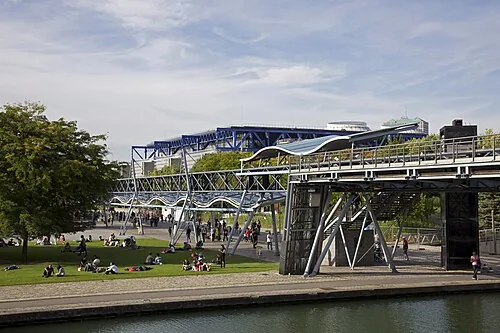
Parc de la Villette, in the 19th arrondissement, is the largest park in Paris at around 55 hectares, built on the site of the city's cattle market and slaughterhouses and opened from 1987. Bernard Tschumi laid it out as a grid of bright red steel follies rather than lawns and borders. It is also a cultural campus, with the science museum, the Philharmonie and a cinema inside its boundaries. An hour covers the walk.
Open in the planner →Getting there
Métro 7 to Porte de la Villette serves the northern end, by the science museum, and Métro 5 to Porte de Pantin serves the southern end, by the Philharmonie and the Grande Halle; both are about 20 minutes from Châtelet. Walking the park from one to the other takes 20 to 25 minutes, which is the best way to see it. Tram T3b stops at both gates. The Canal de l'Ourcq runs through the middle, and you can also arrive on foot or by bike along the towpath from the Bassin de la Villette.
What you see
The red follies are the organising device: a grid of cube-shaped steel pavilions, some stairs to nowhere, some cafes or information points, spaced every 120m. The Canal de l'Ourcq cuts across with lifting bridges, and the Canal Saint-Denis joins at the north-west. Working south you pass the Géode's mirrored sphere and the submarine Argonaute beached beside it, then the themed gardens — the Jardin des Dunes et des Vents for children, the Jardin des Bambous sunk below ground level, the Jardin des Miroirs in the trees. At the southern end the nineteenth-century iron Grande Halle, the old cattle hall, now holds exhibitions and events.
What to pair it with
The Cité des Sciences et de l'Industrie is inside the park, and the Philharmonie de Paris is at the other end of it. The Bassin de la Villette and the Canal Saint-Martin walk start just south of Porte de Pantin, and Père Lachaise is a short hop on Métro 3b or by bus.
When to go
Summer evenings are the park at its busiest and best, when the open-air cinema runs on the big lawn and the canal banks fill up. Weekends bring families and sports pitches in use. In winter it can feel like a lot of concrete and wet grass, so pick a bright day. The park itself is open and free; the institutions inside it keep their own hours, so check before you go.
What is hard about it
This is an architectural park, not a pretty one: large areas are hard surface, the follies have weathered unevenly and the planting is sparse compared with the Luxembourg or Buttes-Chaumont. It is also big, and crossing it on a hot or wet day is a slog with little shade or shelter. The northern edge by Porte de la Villette is rough around the ring road. People who come expecting a garden are usually disappointed; people who come for the buildings are not.
Common questions
How long do you need at Parc de la Villette?
About an hour to walk it end to end with a look at the gardens. A whole day if you add the science museum or a concert.
Which Métro station is best?
Porte de la Villette on line 7 for the science museum end, Porte de Pantin on line 5 for the Philharmonie end. Walk between the two.
Is the park free?
Yes, the park and its gardens are free and open daily. The museums, the Géode and the concert halls inside it are ticketed separately.
Nearby
- Cité des Sciences et de l'IndustrieEurope's largest science museum, with the mirrored Géode beside it
- Philharmonie de ParisJean Nouvel's concert hall, clad in a flock of aluminium birds
More of the same kind
- Jardin du LuxembourgFormal gardens round the Senate, with green chairs and a toy-boat pond
- Tuileries GardenThe formal garden between the Louvre and the Concorde
- Bois de BoulogneThe city's western wood, with lakes, gardens and racecourses
- Coulée verte René-DumontA planted walk along a disused viaduct, the first of its kind