Philharmonie de Paris
Jean Nouvel's concert hall, clad in a flock of aluminium birds
- Area La Villette
- Type Landmark
- Time needed 1h 30m
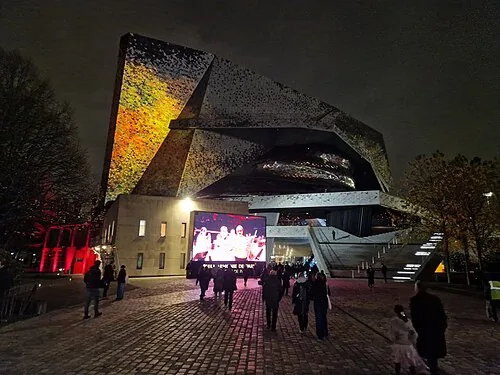
The Philharmonie de Paris, at the southern edge of Parc de la Villette, is a concert hall first and a sight second: Jean Nouvel's 2015 building, clad in interlocking aluminium birds, holds the 2,400-seat Grande Salle Pierre Boulez and is home to the Orchestre de Paris. Next door, in the older Cité de la Musique building, is the Musée de la Musique, a collection of several thousand instruments. If you turn up without a ticket you see the exterior and the museum, not the auditorium.
Open in the planner →Getting there
Métro 5 to Porte de Pantin is the stop, about 20 minutes from Châtelet, and the building is two minutes from the station across the park gate. Tram T3b stops at Porte de Pantin too. Métro 7 to Porte de la Villette works if you want to walk the length of the park first, which takes 20 to 25 minutes. For an evening concert the Métro is fine in both directions, as line 5 runs late.
What you see
From outside, the point is the cladding: thousands of aluminium birds in grey, black and white tessellating over a sloping form you can walk up. Inside the Musée de la Musique the collection runs chronologically from the sixteenth century, with viols, harpsichords, early pianos and a strong holding of nineteenth-century French instruments, plus a non-European section; many cases have a listening station so you hear the instrument you are looking at. There is a glazed view down into the organ and over the rehearsal spaces, and temporary exhibitions on composers and performers. The Grande Salle itself, a timber-lined room with balconies wrapping right around the orchestra, is only seen if you have a concert ticket or join an architecture tour when one runs.
What to pair it with
Parc de la Villette is immediately outside, and the Cité des Sciences et de l'Industrie is at the other end of it. The Grande Halle de la Villette next door often has an exhibition on, and the canal walk south towards the Bassin de la Villette is a good way to leave.
When to go
Go in the afternoon for the museum, and come back in the evening if you want a concert; the two work well as one trip. The museum is quietest on weekday afternoons and busiest at weekends. Concert programming runs heaviest from autumn to spring and thins in high summer. Check opening and programme before you go, since the museum closes one day a week and the hall's calendar varies.
What is hard about it
The main hall is not a visitor attraction: without a ticket you cannot normally get into it, and people who come expecting to look round the auditorium leave disappointed. The museum is a serious instrument collection rather than a spectacle, and it is quiet work if you are not musically minded. The building's exterior has weathered and discoloured in places, and the surroundings by the ring road are bleak. Concert tickets for the better-known programmes need booking well ahead.
Common questions
How long do you need at the Philharmonie?
About 90 minutes for the Musée de la Musique and a walk round the exterior. A concert is a separate two hours or so in the evening.
Can you see the concert hall without a ticket?
Generally no. The Grande Salle Pierre Boulez opens for performances and for occasional guided architecture tours, so a concert ticket is the reliable way in.
Is the Musée de la Musique worth it?
Yes if you have any interest in instruments, helped by the listening stations at the cases. It is in the Cité de la Musique building beside the concert hall, not inside it.
Nearby
- Parc de la VilletteThe largest park in Paris, scattered with bright red follies
- Cité des Sciences et de l'IndustrieEurope's largest science museum, with the mirrored Géode beside it
More of the same kind
- Eiffel TowerGustave Eiffel's 330-metre iron tower, the one unmistakable thing on the skyline
- Arc de TriompheNapoleon's arch at the top of the Champs-Élysées, with a roof terrace
- Palais GarnierGarnier's opera house, all marble staircase, gold and Chagall ceiling
- Place de la ConcordeThe largest square in Paris, with an Egyptian obelisk at its centre