Cité des Sciences et de l'Industrie
Europe's largest science museum, with the mirrored Géode beside it
- Area La Villette
- Type Museum
- Time needed 2h
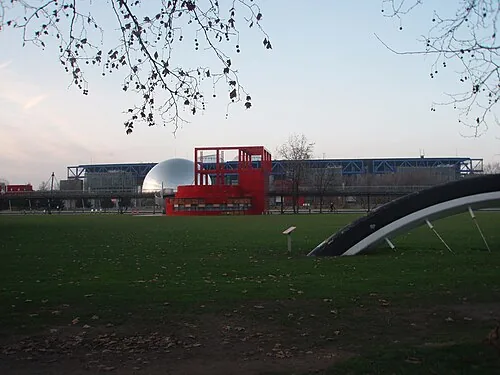
The Cité des Sciences et de l'Industrie, at the northern end of Parc de la Villette, is the largest science museum in Europe, opened in 1986 in a converted auction hall. Its permanent galleries, Explora, run over two upper floors, and there is a separate children's city for younger visitors. The mirrored Géode dome and the decommissioned submarine Argonaute stand outside it. Two hours is a sensible minimum.
Open in the planner →Getting there
Métro 7 to Porte de la Villette puts you at the main entrance, about 20 minutes from Châtelet with no change; the building is a two-minute walk from the station exit. Métro 5 to Porte de Pantin and a 20-minute walk north through the park is the better approach if you want to see La Villette on the way. Tram T3b stops at Porte de la Villette as well.
What you see
The entrance hall is a vast glazed void with ramps and bridges crossing it, which sets the tone. Upstairs, Explora is a run of permanent galleries on mathematics, sound, light, the brain, energy and transport, nearly all of them hands-on rather than cases of objects; the aeronautics and space sections hold real aircraft and capsules. The Planetarium sits inside the building and runs timed shows. Outside, the Argonaute can be boarded and walked through end to end, and the Géode's hemispherical screen shows large-format films; both are ticketed separately from the museum.
What to pair it with
Parc de la Villette surrounds it, and the Philharmonie de Paris and its instrument museum are at the far southern end of the park. The Bassin de la Villette and the canal walk back towards Jaurès make a good onward route.
When to go
Weekday mornings in term time are the calmest for adults; after school, at weekends and through French school holidays the place is loud and full of children, which is what it is for. The Planetarium and Géode sessions are timed and fill up, so sort those first if you want them. The museum closes one day a week, so check before you go.
What is hard about it
It is designed for families, and some exhibits are worn, broken or out of service at any given time. Much of the signage and many of the interactive prompts are in French only, which blunts the hands-on galleries if you do not read it. The building is huge and tiring, the layout is not intuitive, and the Géode has been closed for long periods. Adults without children often come away feeling they paid for a school trip.
Common questions
How long do you need at the Cité des Sciences?
Two hours for a selective pass through Explora, three or four with children. Add an hour for the Planetarium or a Géode film.
Is it good for adults on their own?
Parts of it are — the aeronautics, space and brain galleries work for anyone — but the museum is pitched at families and school groups.
Is the Géode included in the ticket?
No. The Géode, the Planetarium, the Argonaute and the children's city are generally ticketed separately, and the Géode has had long closures.
Nearby
- Parc de la VilletteThe largest park in Paris, scattered with bright red follies
- Philharmonie de ParisJean Nouvel's concert hall, clad in a flock of aluminium birds
More of the same kind
- LouvreThe largest art museum on earth, in a palace, behind a glass pyramid
- Musée d'OrsayImpressionism in a converted railway station, under the great clock
- Centre PompidouModern art behind the inside-out pipes of Rogers and Piano
- Musée RodinThe Thinker and the Gates of Hell in a mansion with a sculpture garden