Jardin du Luxembourg
Formal gardens round the Senate, with green chairs and a toy-boat pond
- Area Latin Quarter
- Type Park
- Time needed 1h
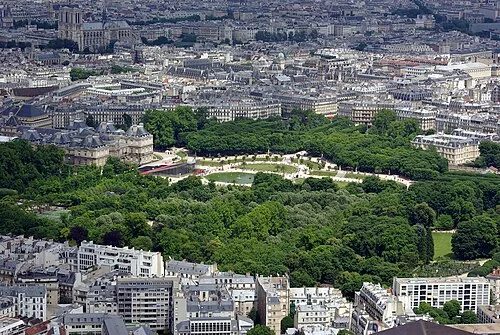
The Jardin du Luxembourg covers about 23 hectares on the edge of the Latin Quarter, laid out from 1612 for Marie de Medici around the palace that now houses the French Senate. It is the formal garden Parisians actually use, with the movable green metal chairs, the octagonal pond where children sail hired toy boats, and a long run of statues and tennis courts and orchards behind the lawns. Entry is free. The palace itself is not generally open to visitors.
Open in the planner →Getting there
The quickest approach is RER B to Luxembourg, which comes up at the main gate on the boulevard Saint-Michel and takes about 5 minutes from Châtelet–Les Halles. On the Métro, Odéon (lines 4 and 10) and Saint-Placide or Notre-Dame-des-Champs (line 12) are each a 5 to 10 minute walk to a different gate, and Cluny–La Sorbonne on line 10 is about 10 minutes. The garden has gates on all four sides, so check which corner you want before you pick a station; the pond and the palace are nearest the RER entrance.
What you see
Come in from the boulevard Saint-Michel and you meet the garden at its best: the balustraded terrace above a sunken parterre, the Grand Bassin in the middle of it, and the Senate building across the gravel with its ground-floor facade. Pull a green chair to the edge of the pond and you have the standard Luxembourg experience. Walk west behind the palace for the Medici Fountain, a long shaded basin at the end of a plane-tree alley with the Polyphemus sculpture group at its head, which is the single best corner of the garden. The terraces carry a sequence of statues of French queens and notable women, and there is a scaled-down Statue of Liberty model among the trees on the west side. Beyond the formal part are a bandstand, an orchard of trained fruit trees, beehives, an orangery used for exhibitions, an enclosed playground and a puppet theatre, plus courts for tennis and areas set aside for chess and boules.
What to pair it with
The Panthéon is about ten minutes uphill to the east, and the Sorbonne quarter lies between them. Saint-Sulpice is five minutes north of the garden, and Montparnasse is fifteen minutes south.
When to go
Weekday mornings are calm and the gardeners are still at work. Sunny weekend afternoons are the busiest, and every chair round the pond will be taken by midday. Late spring is when the parterre planting is at its fullest and the orange trees are brought out; autumn gives you the plane leaves and far fewer people. The garden opens around dawn and closes at dusk, with the closing time moving through the year, so check before an evening visit. Whistles and a patrol sweep the paths at closing, which comes earlier than most people expect in winter.
What is hard about it
The gates shut at dusk and the guards clear the garden firmly, so a late-afternoon visit in winter can be very short. The chairs are plentiful but the shaded ones go first on a hot day and there is a lot of open gravel. Lawns are mostly fenced off and sitting on the grass is only allowed in a few marked areas, which surprises people expecting a London-style park. The palace is the working Senate and cannot normally be toured. Dogs are not allowed, and cycling inside the garden is not either.
Common questions
How long do you need at the Jardin du Luxembourg?
An hour is enough for the pond, the terraces and the Medici Fountain. Two hours if you want to sit with a coffee or let children use the playground and boats.
Does it cost anything to get in?
No, the garden is free to enter. The toy boats, the playground and the puppet theatre are paid separately and are inexpensive.
Can you go inside the Luxembourg Palace?
Not as a general visitor, since it is the seat of the Senate. The Musée du Luxembourg in the adjoining wing holds ticketed temporary exhibitions and is open to everyone.
Nearby
- PanthéonNeoclassical mausoleum of the Republic's great, with Foucault's pendulum
- Institut du monde arabeNouvel's photo-sensitive screen wall, and a roof terrace above the Seine
- Jardin des PlantesThe botanical garden, with greenhouses and the natural history galleries
- Grand Mosque of ParisHispano-Moorish courtyards, a tiled patio and a tearoom
- Shakespeare and Company (bookstore)The English-language bookshop facing Notre-Dame across the river
- Musée de ClunyThe Lady and the Unicorn tapestries, over a Roman bath house
More of the same kind
- Tuileries GardenThe formal garden between the Louvre and the Concorde
- Parc de la VilletteThe largest park in Paris, scattered with bright red follies
- Bois de BoulogneThe city's western wood, with lakes, gardens and racecourses
- Coulée verte René-DumontA planted walk along a disused viaduct, the first of its kind