Grand Mosque of Paris
Hispano-Moorish courtyards, a tiled patio and a tearoom
- Area Latin Quarter
- Type Church
- Time needed 45m
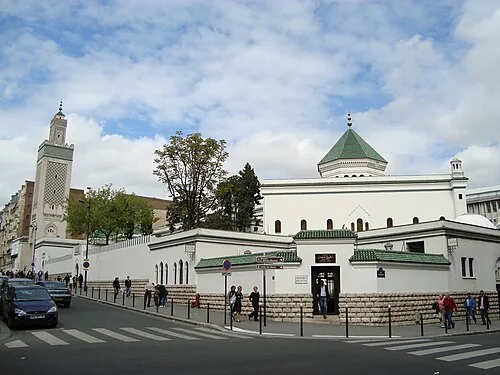
The Grande Mosquée de Paris was built between 1922 and 1926 in the 5th arrondissement, in a Hispano-Moorish style modelled partly on the Qaraouiyine mosque in Fez, as a memorial to Muslim soldiers who died for France in the First World War. Visitors are admitted to the courtyards, the tiled patio and the gardens outside prayer times, but not to the prayer hall. There is also a tearoom and hammam on the rue Geoffroy-Saint-Hilaire side, open to the public and used as much by students from the nearby campuses as by tourists.
Open in the planner →Getting there
Censier-Daubenton on Métro line 7 is about five minutes' walk and the simplest approach; from Chatelet it is roughly twelve minutes on line 7. Place Monge on line 7 is a similar distance, and Gare d'Austerlitz on lines 5 and 10 or RER C is around twelve minutes on foot through the Jardin des Plantes. The visitor entrance is on the place du Puits-de-l'Ermite, which is not the same door as the tearoom.
What you see
The visit is short and almost entirely about surfaces. You come in past the minaret, which stands about 33 metres and is the tallest thing on this stretch of street, into a cloistered courtyard of horseshoe arches with zellij tilework to shoulder height and carved cedar above. The garden court beyond is planted with fig and olive and centred on a long rectangular pool, in the Andalusian manner, and is the quietest corner of the whole site. You can look into the prayer hall from the doorway without entering, and the mosaic floor and the carved stucco of the mihrab wall are visible from there. The tearoom, reached from the street rather than the courtyards, is a tiled room and shaded terrace serving mint tea and pastries, and is as much the reason people come as the architecture.
What to pair it with
The Jardin des Plantes is directly across the road, and the Arènes de Lutèce and the rue Mouffetard are a few minutes uphill. The Institut du monde arabe is about a twelve-minute walk towards the river.
When to go
Visiting hours are limited and the site closes to visitors at prayer times and all day on Friday, so a weekday morning or early afternoon is the safe choice. Spring and early autumn show the garden court at its best; in high summer the tiled patio is cool and the terrace of the tearoom is full. Check the day's hours before setting out, as they shift with the religious calendar and during Ramadan.
What is hard about it
This is a working mosque and the visit is genuinely brief — two courtyards and a garden, with no access to the prayer hall. There is an admission charge for the visitor route, which surprises some people, and the opening pattern is restrictive and not always as published. Modest dress is expected and headscarves are asked of women in the courtyards. The tearoom is popular, service can be slow and brusque at busy times, and it is a separate entrance from the street; some find it touristy for the price. There is no useful interpretation on site in any language.
Common questions
How long do you need at the Grand Mosque of Paris?
Around 45 minutes for the courtyards and garden. Add an hour if you stop for tea.
Can non-Muslims visit?
Yes, the courtyards, patio and gardens are open to all outside prayer times, on a paid visitor route. The prayer hall itself is not part of the visit.
Is there a dress code?
Dress modestly with shoulders and knees covered; women are normally asked to cover their hair in the courtyards. Scarves are usually available at the entrance.
Nearby
- PanthéonNeoclassical mausoleum of the Republic's great, with Foucault's pendulum
- Jardin du LuxembourgFormal gardens round the Senate, with green chairs and a toy-boat pond
- Institut du monde arabeNouvel's photo-sensitive screen wall, and a roof terrace above the Seine
- Jardin des PlantesThe botanical garden, with greenhouses and the natural history galleries
- Shakespeare and Company (bookstore)The English-language bookshop facing Notre-Dame across the river
- Musée de ClunyThe Lady and the Unicorn tapestries, over a Roman bath house
More of the same kind
- Notre-Dame de ParisThe Gothic cathedral on the Île de la Cité, reopened after the 2019 fire
- Sainte-ChapelleFifteen windows of thirteenth-century glass in a single upper room
- Sacré-Cœur, ParisThe white basilica on the butte, and the best free view in the city
- Basilica of Saint-DenisThe first Gothic building, and the burial place of the French kings