Institut du monde arabe
Nouvel's photo-sensitive screen wall, and a roof terrace above the Seine
- Area Latin Quarter
- Type Museum
- Time needed 1h 30m
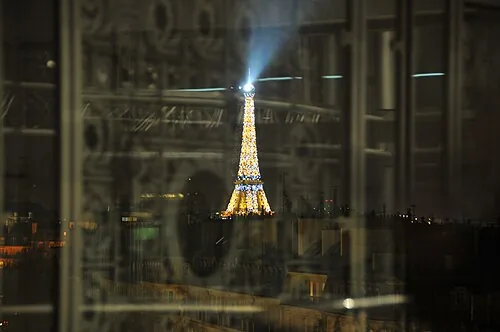
The Institut du monde arabe is a cultural institute on the quai Saint-Bernard, opened in 1987 to a design by Jean Nouvel, and best known for its south wall of mechanical mashrabiya screens that were built to open and close with the daylight. Inside there is a museum of the Arab world across several floors, a library, a bookshop and a free roof terrace with one of the better views of the back of Notre-Dame. It stands on the Left Bank between the Jussieu campus and the Seine.
Open in the planner →Getting there
Jussieu, on Métro lines 7 and 10, is the closest station and about four minutes' walk; from Chatelet it is roughly ten minutes on line 7. Cardinal Lemoine on line 10 and Sully-Morland on line 7 are each a similar walk. The building faces the river, so you can also walk along the quays from the Île Saint-Louis in about ten minutes, crossing at the pont de Sully.
What you see
Start outside on the south facade and look closely at the screen wall: thousands of metal diaphragms in geometric panels, inspired by mashrabiya latticework, designed to act like camera apertures. Inside, the light coming through those panels onto the floors is the real experience, and the glass lifts and the spiral book tower in the library shaft are worth a few minutes on their own. The museum galleries work down through the Arab world by theme rather than strict chronology — astronomical and navigational instruments, ceramics, textiles, calligraphy and manuscripts, with modern and contemporary art on the lower floors. Finish on the roof terrace, which is free to reach by lift and looks out over the Seine, the apse of Notre-Dame, the Panthéon dome and the Institut de France.
What to pair it with
The Jardin des Plantes is a ten-minute walk upriver, and the Grand Mosque of Paris is just beyond it. The Île Saint-Louis and Notre-Dame are a similar walk in the other direction, and the Arènes de Lutèce are a few streets inland.
When to go
Weekday mornings are quiet. Temporary exhibitions here draw real crowds and can mean a queue at the ticket desk, especially at weekends and on the closing weeks. Late afternoon is the best light on the screen wall and on the view from the terrace; the terrace is also worth a detour on a clear evening. The institute closes one day a week, so check before you go.
What is hard about it
The famous light-sensitive screens have been unreliable for years and are often static, so the facade may simply sit there rather than move — this is the single most common disappointment. The permanent museum is modest in size next to the building's reputation, and the display is text-heavy with uneven English labelling. The roof terrace has at times been restricted to the restaurant or closed for private events, and the view, while good, is partly blocked by the parapet and by trees along the quay.
Common questions
How long do you need at the Institut du monde arabe?
About 90 minutes for the museum plus the terrace. A quick visit for the architecture and the view takes half an hour.
Is the roof terrace free?
The terrace is normally free and reached by lift without a museum ticket, but access can be limited by events or by the restaurant, so it is worth checking at the desk.
Do the screens on the facade still move?
Rarely. The mechanism has long been faulty and the panels are usually fixed, so go for the building and the light rather than for a demonstration.
Nearby
- PanthéonNeoclassical mausoleum of the Republic's great, with Foucault's pendulum
- Jardin du LuxembourgFormal gardens round the Senate, with green chairs and a toy-boat pond
- Jardin des PlantesThe botanical garden, with greenhouses and the natural history galleries
- Grand Mosque of ParisHispano-Moorish courtyards, a tiled patio and a tearoom
- Shakespeare and Company (bookstore)The English-language bookshop facing Notre-Dame across the river
- Musée de ClunyThe Lady and the Unicorn tapestries, over a Roman bath house
More of the same kind
- LouvreThe largest art museum on earth, in a palace, behind a glass pyramid
- Musée d'OrsayImpressionism in a converted railway station, under the great clock
- Centre PompidouModern art behind the inside-out pipes of Rogers and Piano
- Musée RodinThe Thinker and the Gates of Hell in a mansion with a sculpture garden