Grand Palais
A glass and iron nave built for the 1900 World's Fair
- Area Champs-Élysées
- Type Landmark
- Time needed 1h 15m
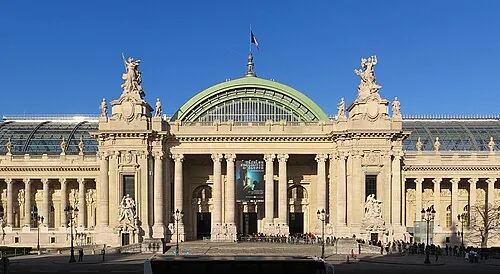
The Grand Palais was built for the 1900 Exposition Universelle and is essentially one vast exhibition hall: a glass and steel nave about 240 metres long under the largest glazed roof in Europe when it opened. It stands on the Avenue Winston-Churchill off the Champs-Élysées, facing the Petit Palais across the road. It reopened in 2024 and 2025 after a restoration lasting several years, so the building itself is in the best condition it has been in for decades.
Open in the planner →Getting there
Metro line 1 or 13 to Champs-Élysées Clemenceau sets you down at the door. From Châtelet take line 1 westbound, roughly ten minutes. Line 8 or 13 to Invalides, or RER C to Invalides, is a seven to eight minute walk across the Pont Alexandre III, which is the better arrival on foot. Concorde, on lines 1, 8 and 12, is about ten minutes along the gardens.
What you see
The nave is the reason to go in: a single clear span under a curved glass vault on riveted steel arches, with a double staircase of stone and ironwork rising at one end and ornamental metal balustrades throughout. The restoration reopened sightlines that had been blocked for years, so you can now read the whole length of the building from inside. What is actually displayed under the roof changes constantly, since the building hosts large temporary exhibitions, art fairs, fashion shows and sporting events rather than a permanent collection; check what is on before you commit to a ticket. The Palais de la Découverte, the science museum in the west wing, operates separately. From outside, walk around to see the quadrigas and the stone frieze on the Champs-Élysées front.
What to pair it with
The Petit Palais is directly opposite and is free to enter. The Champs-Élysées and the Arc de Triomphe run uphill to the west, and the Pont Alexandre III and Invalides are over the river to the south.
When to go
Tie your visit to an exhibition you want to see rather than to a time of day. The nave takes light from above, so a bright day shows the glazing at its best and a grey one makes the hall feel flat. Major exhibitions and fairs sell out their weekend slots first; weekday mornings are the easier option. Some events close parts of the building off entirely, so confirm before travelling.
What is hard about it
There is no permanent collection, so on some days there is little or nothing to go inside for, and entry is tied to whichever exhibition or event is running. Tickets are per-exhibition and timed booking is normally needed; popular shows queue even with a slot. The hall is glazed, which means it gets hot in summer and cold in winter. Visitors who come expecting a museum in the ordinary sense sometimes find they have paid for a trade fair.
Common questions
How long do you need at the Grand Palais?
Allow about an hour and a quarter for a typical temporary exhibition plus time to look at the nave. A large show can easily take two hours.
Can I see the glass nave without a ticket?
Generally not: the nave is inside the ticketed area and access depends on what is running. The entrance halls and the exterior ironwork can be seen for nothing.
Is it worth going if nothing interests me on the programme?
Probably not. In that case look at the exterior and spend the time in the Petit Palais across the road instead.
Nearby
- Arc de TriompheNapoleon's arch at the top of the Champs-Élysées, with a roof terrace
- Champs-ÉlyséesThe two-kilometre avenue from the Concorde to the Arc de Triomphe
- Petit PalaisThe city's fine-art museum, free, with a garden courtyard
More of the same kind
- Eiffel TowerGustave Eiffel's 330-metre iron tower, the one unmistakable thing on the skyline
- Palais GarnierGarnier's opera house, all marble staircase, gold and Chagall ceiling
- Place de la ConcordeThe largest square in Paris, with an Egyptian obelisk at its centre
- Les InvalidesThe gilded dome over Napoleon's tomb, and the army museum beneath