Place de la Bastille
Where the prison stood, now a column and a traffic circle
- Area Bastille
- Type Landmark
- Time needed 25m
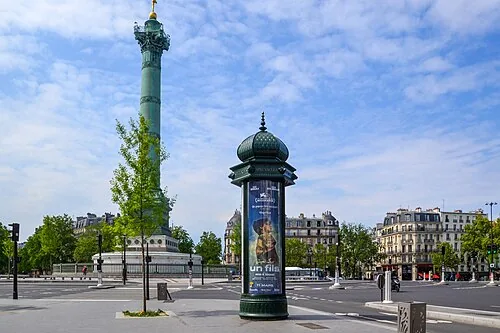
Place de la Bastille is where the Bastille prison stood until it was stormed on 14 July 1789 and demolished; nothing of it remains above ground except a line of paving stones marking the foundations. The July Column in the middle, finished in 1840, commemorates the dead of the 1830 revolution rather than 1789. It is a large open square and traffic junction between the 4th, 11th and 12th, free and open at all hours.
Open in the planner →Getting there
Metro 1, 5 and 8 all meet at Bastille, which is directly under the square; from Châtelet it is about six minutes on line 1. Buses 20, 29, 69, 76, 86, 87 and 91 converge here. The platform of line 5 towards Bobigny carries remains of a counterscarp wall of the fortress behind glass, visible from the train, and there is interpretation about the prison in the station passages. Above ground, a recent redesign has pedestrianised a large part of the square, so crossing to the column is now straightforward.
What you see
The July Column is a bronze-clad shaft about 50 metres high with a gilded figure of the Spirit of Liberty on top; the dead of 1830 are buried in its base, and their names are cut into the bronze. It is not open to the public. The outline of one of the fortress towers is picked out in pale paving stones near the entrance to rue Saint-Antoine — easy to walk over without noticing, so look for it. On the south-east side is the Opéra Bastille, Carlos Ott's glass and grey curve opened in 1989 for the bicentenary, and behind it the Port de l'Arsenal, a marina of moored boats in the old canal basin, with a garden along the quay. The square itself is the traditional starting or finishing point for Paris demonstrations.
What to pair it with
The Coulée verte René-Dumont begins a few minutes east, the Canal Saint-Martin surfaces here at the Port de l'Arsenal, and the Marais and Place des Vosges are a ten-minute walk north-west.
When to go
There is no best time to see a square, but mornings are calmer and the pedestrianised areas are pleasant then. Evenings and weekends the surrounding bars on rue de la Roquette and rue de Lappe fill up and the noise is considerable. Bastille Day on 14 July and the regular demonstrations bring closures and large crowds. The Port de l'Arsenal garden is best on a spring or summer afternoon.
What is hard about it
This is the most commonly regretted stop in Paris for first-time visitors: the prison is gone, the column is closed, and what you get is a busy road junction with a monument to a different revolution in the middle. Traffic still circles part of it and the noise is constant. The square is exposed, with little shade. The Opéra Bastille is widely thought ugly and tours of it are limited and need booking. Come because you are passing or heading for the marina and the Coulée verte, not for the history alone.
Common questions
How long do you need at Place de la Bastille?
Twenty-five minutes, which is the column, the paving outline of the fortress and a look at the Opera. Add half an hour for the Port de l'Arsenal.
Can you see anything of the Bastille prison?
Very little. A line of paving marks a tower's foundations on the square, and a piece of the fortress wall is displayed on the line 5 Metro platform.
Can you climb the July Column?
No. It is not open to visitors, and there is no public access to the interior staircase.
Nearby
More of the same kind
- Eiffel TowerGustave Eiffel's 330-metre iron tower, the one unmistakable thing on the skyline
- Arc de TriompheNapoleon's arch at the top of the Champs-Élysées, with a roof terrace
- Palais GarnierGarnier's opera house, all marble staircase, gold and Chagall ceiling
- Place de la ConcordeThe largest square in Paris, with an Egyptian obelisk at its centre