Opéra Bastille
The glass opera house of 1989, where most of the repertoire is staged
- Area Bastille
- Type Landmark
- Time needed 1h 15m
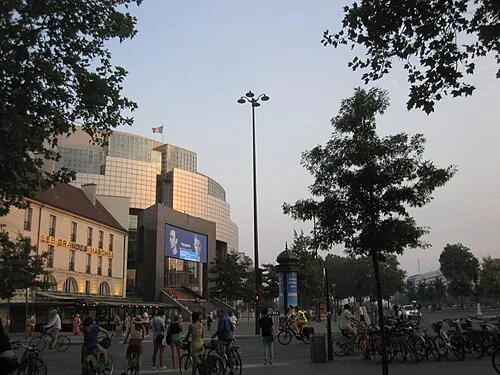
The Opéra national de Paris opened its second house on the place de la Bastille in 1989, on the bicentenary of the Revolution, to a design by Carlos Ott. Most of the company's opera repertoire is staged here rather than at the Palais Garnier, in an auditorium seating around 2,700 with a sightline to the stage from almost every seat. From the street it is a curved grey-and-glass block on the south side of the square, and far less loved than the Garnier.
Open in the planner →Getting there
Bastille, on Métro lines 1, 5 and 8, surfaces directly in front of the building; from Chatelet it is about five minutes on line 1 with no change. The main entrance is on the place itself, up a broad flight of steps on the corner of the rue de Lyon. Gare de Lyon is one stop further on line 1 if you are arriving by train, and a walk of about ten minutes. Several bus routes cross the square, which is useful in the evening when the Métro is crowded after a performance.
What you see
Without a ticket there is very little to go inside for: the box office and the foyer, and otherwise the exterior only. What you can do instead is the guided backstage tour, which runs on a schedule published in advance and normally needs booking; it takes you through the main auditorium, down to the understage machinery, and past the workshops where sets and costumes are built, which is the part most people remember. The building itself rewards a slow circuit from the outside — the glazed drum facing the square, the curved flank along the rue de Lyon, the service and scenery doors round the back that show how large the stage house really is. If you are coming for a performance, the foyer levels give views back over the place de la Bastille and the July Column at its centre.
What to pair it with
Place de la Bastille sits at the head of the Coulée verte René-Dumont, the planted walkway along the old viaduct, which runs east from just behind the opera house. The Marais and the Musée Carnavalet are a fifteen-minute walk north-west, and the Promenade Plantée leads towards the Bois de Vincennes if you want a longer afternoon.
When to go
The backstage tours are mostly afternoon slots and go quickly in school holidays, so book as far ahead as you can. For a performance, the season runs roughly from early autumn to midsummer, with little on in high summer. The square is loud and traffic-ringed at any hour; early evening, with the building lit and the crowd gathering on the steps, is when it looks best.
What is hard about it
The honest drawback is that this is a working opera house and not a sight. If you turn up without a ticket or a tour booking, you will look at a 1980s concrete-and-glass exterior on a busy roundabout and be done in ten minutes. The architecture has been criticised since it opened, the stone cladding has had repair campaigns, and visitors expecting the gilt and chandeliers of the Palais Garnier are reliably disappointed. Tour places are limited and sell out; routes vary with what is being rehearsed, so you may not see the stage in use.
Common questions
How long do you need at the Opéra Bastille?
Allow around 75 minutes for the guided tour, or an evening for a performance. Exterior only is ten minutes.
Can you go inside without a ticket?
Only as far as the public foyer and box office. To see the auditorium you need either a performance ticket or a place on a guided tour, which normally has to be booked.
Is it better than the Palais Garnier for a visit?
No. The Garnier is the one to visit for the building; the Bastille is the one to visit for the staging and the acoustics.
Nearby
More of the same kind
- Eiffel TowerGustave Eiffel's 330-metre iron tower, the one unmistakable thing on the skyline
- Arc de TriompheNapoleon's arch at the top of the Champs-Élysées, with a roof terrace
- Palais GarnierGarnier's opera house, all marble staircase, gold and Chagall ceiling
- Place de la ConcordeThe largest square in Paris, with an Egyptian obelisk at its centre