Palais de Tokyo
Raw concrete halls given over to contemporary art, open late
- Area 16th arrondissement
- Type Museum
- Time needed 1h 30m
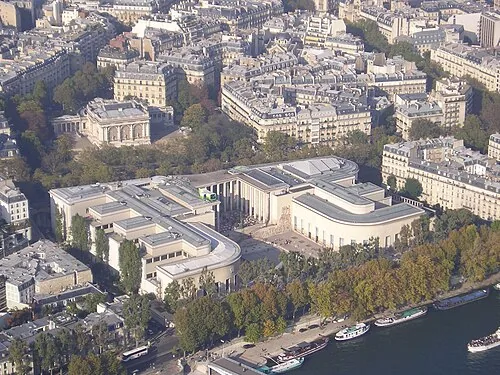
The Palais de Tokyo is a contemporary art centre in the east wing of a building put up for the 1937 International Exposition, on avenue du Président Wilson in the 16th. It has no permanent collection: the whole of its raw concrete interior is handed over to temporary exhibitions, installations and commissions. It is one of the few large art spaces in Paris that stays open into the evening, and it closes one day a week like most French museums.
Open in the planner →Getting there
Metro 9 to Iéna is the closest stop, about two minutes' walk uphill to the entrance; Metro 9 from Chaussée d'Antin or line 1 then 9 puts you there in roughly 15 to 20 minutes from Châtelet. Alma-Marceau on line 9 is an alternative and about the same distance. RER C to Pont de l'Alma works if you are coming along the river, with a five-minute walk up from the quai. The building shares its façade with the Musée d'Art Moderne de Paris, so look for the correct door: the Palais de Tokyo is the west half.
What you see
You come in at the top and descend, which is the point of the place: the floors step down the slope towards the Seine through unfinished concrete, exposed ducts and bare stairwells left deliberately unrefined. Expect large-scale installations that occupy whole halls rather than framed works on walls, so the experience changes completely between exhibition cycles. The lowest levels are the most dramatic, with high ceilings and long sightlines across rough floors. The terrace and the outer colonnade give a view down to the river and across to the Eiffel Tower, and there is a shop and a café on the way in.
What to pair it with
Place du Trocadéro is a ten-minute walk west along the same terrace, and the Musée d'Art Moderne de Paris is in the same building. The Eiffel Tower is across the Pont d'Iéna, about fifteen minutes on foot.
When to go
Late afternoon and evening suit it best, both because the building is open later than most Paris museums and because it is quietest then. Weekend afternoons are the busiest. Because the programme is entirely temporary, check what is actually on before deciding: between exhibition cycles parts of the building are closed for installation. Timed online booking is normally available and worth using at weekends.
What is hard about it
If you do not like contemporary installation art, there is nothing here to fall back on — no old masters, no permanent display, and a visit can be genuinely baffling. The descending layout means stairs, though lifts exist. Some works are text-heavy with limited English labelling, and a few require queueing for single-person entry. It is not covered the same way as the state museums, so check whether a pass applies before you count on it.
Common questions
How long do you need at the Palais de Tokyo?
An hour and a half is about right for a full set of exhibitions. If only one hall is open you could be through in forty minutes.
Is there a permanent collection?
No. Everything is temporary, so two visits a year apart will have nothing in common.
Is it suitable for children?
Some installations are, some are explicitly flagged as unsuitable. Check the current programme rather than assuming.
Nearby
- Bois de BoulogneThe city's western wood, with lakes, gardens and racecourses
- Place du TrocadéroThe terrace that frames the Eiffel Tower across the river
- Musée Marmottan MonetThe largest Monet collection, including Impression, Sunrise
More of the same kind
- LouvreThe largest art museum on earth, in a palace, behind a glass pyramid
- Musée d'OrsayImpressionism in a converted railway station, under the great clock
- Centre PompidouModern art behind the inside-out pipes of Rogers and Piano
- Musée RodinThe Thinker and the Gates of Hell in a mansion with a sculpture garden