Chapelle expiatoire
A quiet chapel where Louis XVI and Marie-Antoinette were first buried
- Area 8th arrondissement
- Type Church
- Time needed 30m
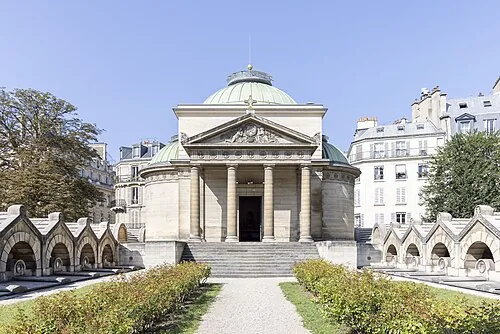
The Chapelle expiatoire stands on the site of the Madeleine cemetery, where the bodies of Louis XVI and Marie-Antoinette were buried after their executions in 1793. Louis XVIII had the chapel built in the 1810s and 1820s once the remains had been moved to Saint-Denis. It sits inside the small Square Louis XVI in the 8th arrondissement, a few minutes from the department stores of Boulevard Haussmann, and almost nobody walking past knows it is there.
Open in the planner →Getting there
The nearest station is Saint-Augustin on Métro line 9, about two minutes on foot. Havre-Caumartin on lines 3 and 9 and Saint-Lazare on lines 3, 12, 13 and 14 are both within five minutes, and Saint-Lazare also takes RER E. From Châtelet, line 14 to Saint-Lazare is the quickest run, roughly ten minutes plus the walk; line 9 from Châtelet means changing, usually at République or Havre-Caumartin. The entrance is on Rue Pasquier, through the railings of the square rather than from the boulevard, which is why people overshoot it.
What you see
You enter through a colonnaded forecourt lined with low stone cenotaphs, which mark the burial trenches of Swiss Guards killed at the Tuileries in 1792. Beyond it the chapel proper is a small domed neoclassical space, very plain, lit from above. Two large white marble groups face each other across the floor: Louis XVI supported by an angel on one side, Marie-Antoinette with a figure of Religion on the other, each with the text of a letter carved into the base. Steps lead down to the crypt chamber, where a black and white marble altar marks the spot where the bodies were found. The whole thing is one room, a forecourt and a crypt, and you have seen it in half an hour.
What to pair it with
The Madeleine church is a ten-minute walk south, and the Place de la Concorde beyond it. Saint-Augustin and the Boulevard Haussmann stores are next door, and the Musée Jacquemart-André is a reasonable walk north-west.
When to go
Opening is limited and seasonal, with fewer days in winter than in summer, so check before you go rather than turning up. Afternoons give the best light through the dome. It is never crowded; on a weekday you may have the chapel to yourself, and even at its busiest it is a handful of people. The square around it closes at dusk.
What is hard about it
It is a thirty-minute stop at most, and the opening days are narrow enough that a wasted journey is the real risk. There is an admission charge for a single room, which some visitors find steep for what it is, and the interpretation on site is thin if you do not already know the story of 1793. The crypt steps are not step-free, and the chapel is unheated and cold in winter.
Common questions
How long do you need at the Chapelle expiatoire?
Thirty minutes covers the forecourt, the chapel and the crypt without rushing. Add ten if you want to read the carved inscriptions properly.
Are Louis XVI and Marie-Antoinette buried here?
No. They were buried here in 1793, but the remains were exhumed in 1815 and reinterred in the Basilica of Saint-Denis before the chapel was finished.
Does the Paris Museum Pass cover it?
It is one of the national monuments usually included, but pass coverage and opening days both change, so confirm on the day you plan to visit.
Nearby
- La Madeleine, ParisA Roman temple from the outside, a church within
- Parc MonceauAn English-style park with a colonnade and scattered follies
- Musée Jacquemart-AndréA collector's mansion left exactly as its owners arranged it
More of the same kind
- Notre-Dame de ParisThe Gothic cathedral on the Île de la Cité, reopened after the 2019 fire
- Sainte-ChapelleFifteen windows of thirteenth-century glass in a single upper room
- Sacré-Cœur, ParisThe white basilica on the butte, and the best free view in the city
- PanthéonNeoclassical mausoleum of the Republic's great, with Foucault's pendulum