Parc Monceau
An English-style park with a colonnade and scattered follies
- Area 8th arrondissement
- Type Park
- Time needed 45m
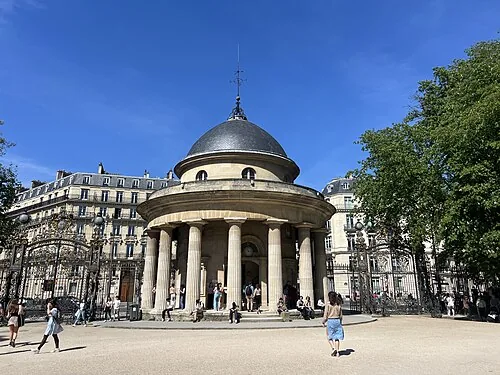
Parc Monceau is a small English-style park in the 8th arrondissement, laid out from 1778 for the Duke of Chartres as a jardin anglo-chinois full of follies, and remodelled by Alphand in the 1860s when Haussmann drove the surrounding boulevards through. Its best-known feature is the Naumachie, an oval pond edged with a curved Corinthian colonnade reused from an unfinished royal mausoleum at Saint-Denis. It is ringed by some of the most expensive apartment buildings in Paris and used mainly by local families, joggers and nannies.
Open in the planner →Getting there
Monceau on Métro line 2 comes up at the main gates on the boulevard de Courcelles, about a minute's walk; from Chatelet it is roughly 20 minutes, changing at Barbès-Rochechouart or via line 1 and 2. Villiers on lines 2 and 3 is five minutes from the north-west corner, and Courcelles on line 2 five minutes from the east. The grand rotunda gate with the gilded ironwork at the Monceau entrance is the one to come in by.
What you see
You enter through the Rotonde de Chartres, one of Ledoux's 1780s tollhouses from the old customs wall, now the park keeper's lodge, under gilded gates. The paths loop rather than run straight, and the follies appear one at a time in the manner the eighteenth century intended: the Naumachie colonnade on its pond, with ducks and carp and often a wedding party being photographed; a Renaissance arcade salvaged from the old Paris Hôtel de Ville after it burned in 1871; a small Egyptian pyramid, a stone bridge copied from the Rialto, and fragments of column and urn set among the lawns. Scattered through the grass are nineteenth-century busts of Chopin, Maupassant and Gounod, and a few very large plane and oriental sycamore trees, one of which is among the thickest in the city. Children head for the playground and the carousel at the north end.
What to pair it with
The Musée Nissim de Camondo and the Musée Jacquemart-Andre, both private mansions kept as they were furnished, are within a few minutes of the park gates and make the natural combination. The Musée Cernuschi, on the park's own railings, holds Asian art and is free for its permanent collection.
When to go
Early morning is runners and dog walkers and is the best light through the trees; late afternoon after school brings the families. Weekend lunchtimes are the fullest, and the lawns are opened for sitting on only in parts and in the warmer months. Autumn colour here is good because of the mature planes and maples; in winter the park is bare and quickly walked. Gates open early and shut at dusk, earlier in winter.
What is hard about it
It is small — a circuit takes 20 minutes at a slow pace — and once the follies are seen there is not much to detain you. Much of the grass is fenced off, so there are fewer places to sit than the space suggests, and the benches on the main loop fill up. It is also genuinely a residential park with no real facilities, limited toilets and nothing in the way of a cafe inside beyond a kiosk. Anyone travelling across Paris specifically for it will probably wonder why; it works as an adjunct to the two mansion museums next door, not as a destination.
Common questions
How long do you need at Parc Monceau?
About 45 minutes to walk the loop and look at the follies. Longer if you are sitting with children or a book.
Is Parc Monceau free?
Yes, it is a public park, free and open daily from early morning until dusk.
What is the colonnade by the pond?
The Naumachie, an oval basin framed by a curved Corinthian colonnade whose columns were brought from an unfinished Valois mausoleum at Saint-Denis.
Nearby
- La Madeleine, ParisA Roman temple from the outside, a church within
- Musée Jacquemart-AndréA collector's mansion left exactly as its owners arranged it
- Chapelle expiatoireA quiet chapel where Louis XVI and Marie-Antoinette were first buried
More of the same kind
- Jardin du LuxembourgFormal gardens round the Senate, with green chairs and a toy-boat pond
- Tuileries GardenThe formal garden between the Louvre and the Concorde
- Parc de la VilletteThe largest park in Paris, scattered with bright red follies
- Bois de BoulogneThe city's western wood, with lakes, gardens and racecourses