Musée Carnavalet
The history of Paris itself, free, in two Marais mansions
- Area Le Marais
- Type Museum
- Time needed 2h
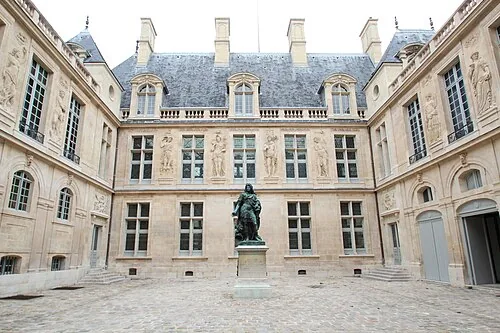
The Musée Carnavalet is the museum of the history of Paris, occupying two linked Renaissance mansions in the Marais, the Hôtel Carnavalet and the Hôtel Le Peletier de Saint-Fargeau, with a collection of around 600,000 items running from prehistory to the present. It reopened in 2021 after a long renovation that opened up the basements and reorganised the route. The permanent collection is free to enter, which makes it one of the better value hours in the city.
Open in the planner →Getting there
Saint-Paul on Métro line 1 is about five minutes' walk and the easiest approach; from Chatelet it is three minutes on line 1. Chemin Vert on line 8 is a similar walk from the north, and Rambuteau on line 11 about eight minutes. The entrance is on the rue des Francs-Bourgeois; the old door on the rue de Sévigné is no longer the way in.
What you see
You begin in the basement with the archaeology — Neolithic dugout canoes found at Bercy, Gallo-Roman fragments from Lutetia — then work up through medieval and Renaissance Paris with shop and tavern signs hung in a dense display that is one of the museum's signatures. The grand floors above hold the reconstructed interiors, which are the real reason to come: whole panelled and painted rooms lifted from Paris houses that were demolished, including Art Nouveau ones, among them Fouquet's jeweller's shop fitted out by Alphonse Mucha and the Café de Paris interior. The Revolution rooms are extensive and unsettling: models of the Bastille, keys and placards, the cell furnishings associated with the royal family's imprisonment in the Temple, and portraits of the protagonists. There is a suite devoted to Marcel Proust including his brass bed and cork-lined room furniture, nineteenth-century Paris in paintings and photographs of the Haussmann demolitions, and two quiet courtyard gardens that are free to sit in.
What to pair it with
The Place des Vosges is five minutes east and the Maison de Victor Hugo sits in its corner. The Musée Picasso is a few streets north, and the Archives nationales and the Marché des Enfants Rouges are both within ten minutes.
When to go
Weekday mornings are calm; Sunday afternoons in the Marais are the busiest time in the whole quarter and the museum fills up with them. Because entry to the permanent collection is free, there is no booking friction, but that also means school holidays are crowded. The museum closes one day a week. Temporary exhibitions are ticketed and can have a short queue at the desk.
What is hard about it
The collection is enormous and the route is long; the sequence after the renovation is not always obvious and people get turned around, particularly between the two mansions. Labelling has improved but English translation is still patchy in the older rooms. The period interiors are mostly viewed from a rope line or a doorway, so you cannot walk into them. Some visitors find the volume of paintings and furniture numbing without a stronger narrative thread. There are stairs throughout, and while there is lift access it is not the natural route.
Common questions
How long do you need at the Musée Carnavalet?
About two hours for a proper pass through. You could spend half a day, or an hour on the Revolution rooms and the period interiors alone.
Is the Musée Carnavalet free?
The permanent collection is free, as at the other City of Paris museums. Temporary exhibitions are charged separately.
What should you not miss?
The reconstructed shop and apartment interiors, especially the Mucha-designed jeweller's shop, and the Revolution rooms.
Nearby
- Musée PicassoThe largest Picasso collection anywhere, in a Marais mansion
- Place des VosgesThe oldest planned square in Paris, arcaded in red brick
More of the same kind
- LouvreThe largest art museum on earth, in a palace, behind a glass pyramid
- Musée d'OrsayImpressionism in a converted railway station, under the great clock
- Centre PompidouModern art behind the inside-out pipes of Rogers and Piano
- Musée RodinThe Thinker and the Gates of Hell in a mansion with a sculpture garden
Part of these routes
- Le MaraisThe quarter the nineteenth century forgot to rebuild: mansions, squares and two fine museums.
- Paris in five daysA fuller first visit: the island, the Louvre, the Left Bank, Montmartre and Versailles.
- Paris at lengthEverything the other routes cover, spread over unhurried days with nothing rushed.