Saint-Eustache, Paris
A Gothic plan dressed in Renaissance detail, with a vast organ
- Area Les Halles
- Type Church
- Time needed 45m
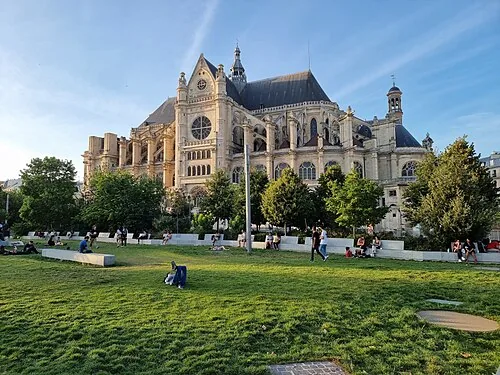
Saint-Eustache stands on the north edge of Les Halles, where the wholesale food market stood until 1971. It was built between 1532 and 1640 on a Gothic plan but detailed in Renaissance classical dress, which is the oddity that defines it: flying buttresses and tall vaults carrying Corinthian pilasters and round arches. It is nearly as large as Notre-Dame and free to enter.
Open in the planner →Getting there
Metro 4 to Les Halles or Metro 1, 4, 7, 11 and 14 and RER A, B and D to Châtelet-Les Halles; from Châtelet it is a five-minute walk north through the Westfield Forum des Halles or across the Jardin Nelson Mandela. Metro 4 to Étienne Marcel is three minutes away on the other side. Buses 29, 67, 74 and 85 stop nearby. The usable entrance is normally the south door facing the garden rather than the west front on rue du Jour.
What you see
The height is what registers first: the vaults are among the tallest in Paris and the double aisles make the interior feel wider than it is. Work round the ambulatory for the chapels, which hold a mixture of periods — 16th-century glass in the choir, 19th-century murals, and a modern triptych in bright colour near the east end. Keller's chapel sculpture and the tomb of Jean-Baptiste Colbert, Louis XIV's finance minister, are in the north side. A folk-art shrine to the market porters, with vegetables modelled in painted relief, recalls the old Halles. The great organ in the west gallery is one of the largest instruments in France, with well over a hundred stops; recitals and the Sunday service give you the chance to hear it, and it is the single best reason to time a visit rather than drop in.
What to pair it with
The Centre Pompidou is a ten-minute walk east, the Louvre about ten minutes south-west, and the Palais Royal gardens twelve minutes west.
When to go
Weekday mornings are quiet and the clerestory light is good. Sunday mass and the advertised organ recitals are the times to come if you want the instrument; the acoustics are large and slow. The garden outside is busiest on weekend afternoons and in the early evening, when the surrounding area fills up. Winter is the best season for concerts.
What is hard about it
The setting does it no favours: the church is hemmed in by the shopping centre and a construction-prone public garden, and the approach is unattractive from every direction. Inside it is dim, and the mixture of styles and periods looks muddled rather than rich to some visitors. Restoration has run in phases for years, so scaffolding and screened chapels are likely in some part of the building whenever you come. The square and garden outside attract rough sleeping and occasional nuisance, and the main west door is often closed.
Common questions
How long do you need at Saint-Eustache?
Forty-five minutes to walk the nave and the full ambulatory. Longer if you stay for an organ recital.
Is it free to enter?
Yes, it is a parish church with free entry. Donations are invited and concerts may be ticketed.
When can you hear the organ?
At Sunday services and at recitals advertised on the church's own notices and website. Check before you travel for it.
More of the same kind
- Notre-Dame de ParisThe Gothic cathedral on the Île de la Cité, reopened after the 2019 fire
- Sainte-ChapelleFifteen windows of thirteenth-century glass in a single upper room
- Sacré-Cœur, ParisThe white basilica on the butte, and the best free view in the city
- PanthéonNeoclassical mausoleum of the Republic's great, with Foucault's pendulum