Père Lachaise Cemetery
The most visited cemetery in the world, cobbled and wooded
- Area 20th arrondissement
- Type Landmark
- Time needed 1h 30m
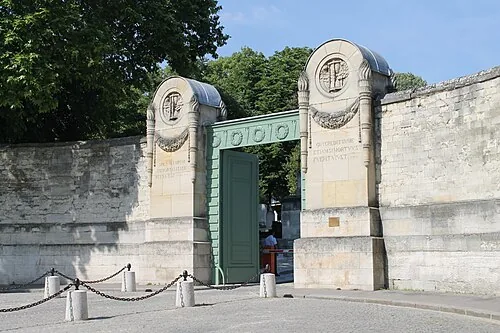
Père-Lachaise opened in 1804 on a hillside in the 20th arrondissement and is the largest cemetery within Paris and the most visited in the world. Around 44 hectares of cobbled lanes and old chestnuts and maples hold the graves of Chopin, Oscar Wilde, Édith Piaf, Jim Morrison, Molière, Balzac, Proust and Gertrude Stein, among tens of thousands of others. It is free to enter and functions as a public park as much as a burial ground.
Open in the planner →Getting there
Metro line 2 or 3 to Père Lachaise sets you near the Boulevard de Ménilmontant side; line 3 to Gambetta brings you in at the top of the hill, which is the easier direction since you then walk downhill. From Châtelet take line 1 to Nation then line 2, or line 11 to Père Lachaise, around twenty minutes either way. The main gate on the Boulevard de Ménilmontant is the one with the maps and the guards who can point you to a grave. Pick up or photograph a plan at the gate; the numbered divisions are the only practical way to find anything.
What you see
From the main gate the central avenue climbs between heavy nineteenth-century family vaults, and the hillside layout means you are working up and across terraces rather than along a grid. Working roughly from the lower gate: Division 11 has Chopin, whose grave is usually the one with fresh flowers; Division 6 has Jim Morrison, now railed off after decades of graffiti; Division 89 has Oscar Wilde's Jacob Epstein monument, a winged modernist figure behind a glass screen covered in lipstick marks; Division 97 holds Édith Piaf and the memorials to those deported during the Second World War, a group of stark sculptural monuments that are among the most affecting things here. The Mur des Fédérés in the south-east corner marks where the last Communards were shot in 1871. Beyond the famous names, what holds attention is the density: chapels, broken columns, cast-iron doors, mossed stone and trees growing through railings.
What to pair it with
Belleville and its street views are a walk north from Gambetta. The Place de la Bastille and the Coulée verte walk are a short ride west on line 1, and the Canal Saint-Martin area is reachable on line 11.
When to go
Mornings on a weekday are quiet and the light comes low through the trees. Autumn is the best season by a distance, with leaf colour and mist on the lanes; late spring is also good. It is busiest at weekends and on 1 November, when Parisians visit family graves. Closes in the late afternoon, earlier in winter, and the guards clear the grounds briskly at closing, so do not arrive late in the day expecting a long wander.
What is hard about it
It is big, confusing and hilly. Without a plan and a willingness to backtrack you will miss the graves you came for, and the division numbers are not always signed where you need them. The lanes are uneven cobbles and worn stone on a slope, which is hard going in a wheelchair or with a pushchair and slippery after rain. Some celebrated graves are modest or railed off and disappoint people who expected a monument. There are few toilets, little shelter and nowhere to buy anything inside. It is also a working cemetery with funerals taking place; mourners are entitled to be left alone.
Common questions
How long do you need at Père-Lachaise?
An hour and a half covers a route taking in several of the well-known graves. Half a day is easy to spend if you want to wander the divisions.
How do I find a particular grave?
Get the plan at the main gate and note the division number before you set off, then follow the numbered divisions rather than trying to navigate by name. Phone maps are unreliable among the vaults.
Is it free to enter?
Yes, it is a municipal cemetery and entry costs nothing. Guided walks are offered separately and are charged.
More of the same kind
- Eiffel TowerGustave Eiffel's 330-metre iron tower, the one unmistakable thing on the skyline
- Arc de TriompheNapoleon's arch at the top of the Champs-Élysées, with a roof terrace
- Palais GarnierGarnier's opera house, all marble staircase, gold and Chagall ceiling
- Place de la ConcordeThe largest square in Paris, with an Egyptian obelisk at its centre