Bibliothèque nationale de France
Four glass towers shaped like open books around a sunken wood
- Area 13th arrondissement
- Type Landmark
- Time needed 1h
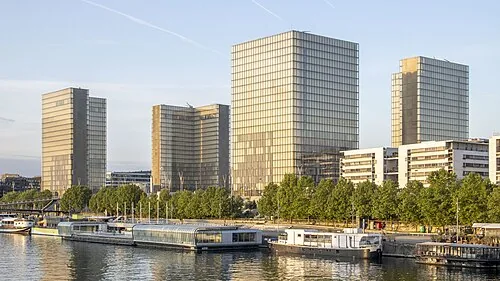
The François-Mitterrand site of the Bibliothèque nationale de France opened in 1996 on the Left Bank in the 13th arrondissement, to a design by Dominique Perrault: four L-shaped glass towers, each shaped like an open book, standing at the corners of a raised wooden esplanade with a sunken pine wood at its centre. It is France's national library, and most of it is a working research institution rather than a sight. What a visitor can do is walk the esplanade, look down into the garden, and go in for the exhibitions and the public-access reading rooms on the upper level.
Open in the planner →Getting there
Bibliothèque François-Mitterrand on Métro line 14 and RER C surfaces at the foot of the east steps; from Chatelet it is about eight minutes on line 14, with no change. Quai de la Gare on line 6 is a ten-minute walk along the river, and tram T3a stops nearby at Avenue de France. The long flight of timber steps up to the esplanade is the usual approach, but there are lifts at the corners if stairs are a problem.
What you see
The esplanade itself is the architecture: a vast deck of ipe wood boards between the four towers, deliberately empty, with the city cut off and the sky very present. From the parapets you look down into the jardin-forêt, a sunken hectare of mature pines and birches moved here as grown trees, which is closed to the public and meant to be seen rather than entered. Inside, the upper Haut-de-jardin level has reading rooms open to any adult visitor with a day pass, arranged in a ring around the garden so that every desk faces the trees through full-height glass. The library mounts substantial temporary exhibitions from its own collections — manuscripts, prints, photographs, maps, the kind of material that is rarely shown — in galleries off the main hall, and there is a permanent display of globes and a reading-room gallery with the Mitterrand-era furniture intact.
What to pair it with
The Parc de Bercy and the Cinémathèque française are across the river by the pont Simone-de-Beauvoir footbridge, five minutes from the esplanade. Les Docks and the Cité de la Mode are a short walk upriver, and the Butte-aux-Cailles is twenty minutes inland.
When to go
Weekdays in term time are busiest with students, though that affects the reading rooms rather than the esplanade. Exhibitions are quiet on weekday mornings and crowded on their final weekends. The esplanade is at its best in late afternoon when the low sun comes off the glass, and bleak in wind or rain, which it channels badly. The library closes one day a week and for a maintenance period in late summer.
What is hard about it
Most of the building is closed to casual visitors, and people who come expecting to see a great national library interior are let down — the towers are offices and stacks, and the famous sunken wood cannot be walked in. The esplanade is windswept, hard-surfaced and has almost no shelter or seating; the timber decking is slippery when wet and has needed repeated replacement. Access to the Haut-de-jardin reading rooms needs a paid pass and photo identification, and exhibitions are ticketed separately. The approach up the steps is long and steep.
Common questions
How long do you need at the Bibliothèque nationale de France?
About an hour for the esplanade and a look into the garden. Add an hour or more for a temporary exhibition.
Can you go into the reading rooms?
The upper Haut-de-jardin level is open to adults with a day pass bought on site, with identification. The research level below it requires an accreditation interview.
Can you walk in the sunken garden?
No. The pine wood at the centre is deliberately closed and is viewed from the esplanade parapets and through the reading-room glass.
More of the same kind
- Eiffel TowerGustave Eiffel's 330-metre iron tower, the one unmistakable thing on the skyline
- Arc de TriompheNapoleon's arch at the top of the Champs-Élysées, with a roof terrace
- Palais GarnierGarnier's opera house, all marble staircase, gold and Chagall ceiling
- Place de la ConcordeThe largest square in Paris, with an Egyptian obelisk at its centre