Moulin Rouge
The red windmill on the Boulevard de Clichy, open since 1889
- Area Pigalle
- Type Landmark
- Time needed 30m
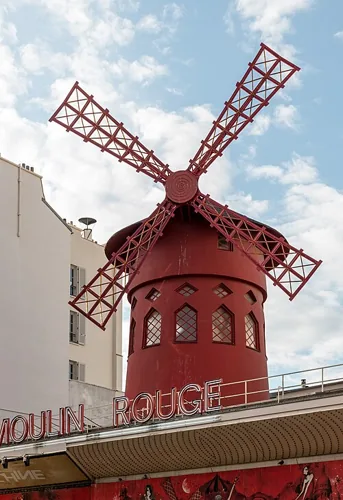
The Moulin Rouge opened in 1889 on the Boulevard de Clichy at the foot of Montmartre and still runs a nightly cabaret, the Féerie revue, built around a line of dancers and the French can-can. The red windmill on the roof is the thing most people come to see, and most of them see it from the pavement opposite. It is a ticketed dinner-and-show venue rather than somewhere you walk into and look around.
Open in the planner →Getting there
Metro line 2 to Blanche puts you directly outside; the exit is a few steps from the facade. From Châtelet take line 4 to Barbès Rochechouart then line 2 one stop, or line 1 to Charles de Gaulle Étoile then line 2, roughly twenty minutes either way. Pigalle, on lines 2 and 12, is a five minute walk east. Montmartre and Sacré-Cœur are ten to fifteen minutes uphill on foot from here.
What you see
From outside there is the windmill itself, repaired after its sails came down in 2024, the red frontage with its lettering and bulbs, and the posters by the doors. That is the whole of the free visit, and it takes a few minutes. If you have a ticket, the show is in a single ground-floor hall seated at long tables facing the stage, with the seats closest to the stage costing most; there is no tour of the building and no museum. The revue itself is a sequence of costumed set pieces with feathers, mirrors and specialty acts between the dance numbers, ending in the can-can. Dinner, where booked, is served at the table before the show begins.
What to pair it with
Montmartre and Sacré-Cœur are a steep walk uphill. The Pigalle area runs east along the same boulevard, and the Montmartre cemetery is a few minutes west.
When to go
The facade photographs best after dark, when the frame and the windmill are lit, and the lighting is the only reason to come at night if you are not seeing the show. Shows run most evenings, usually twice a night, and booking well ahead is normally needed, particularly at weekends and in summer. Daytime, the boulevard is dull and the building looks small and worn in flat light.
What is hard about it
The honest drawback is that there is nothing here for a casual visitor but a facade on a loud, shabby main road, and the pavement in front is crowded with people queuing for photographs. Tickets to the show are expensive, the better seats much more so, and reviews divide sharply between people who find it dazzling and people who find it an overpriced tourist set piece with mediocre food. There is a dress code, no photography during the performance, and seating at shared tables with strangers. The surrounding stretch of Pigalle has sex shops and persistent touts, and the side streets are best avoided late at night.
Common questions
How long do you need at the Moulin Rouge?
Ten minutes if you are photographing the facade from across the boulevard. A show with dinner runs most of an evening, so plan on three to four hours.
Can I go inside without a ticket?
No. The building is a working cabaret, entry is by booked ticket for a performance, and there is no tour or exhibition to visit.
Is the show worth the money?
It depends what you want: the costumes and staging are genuinely lavish, but it is a large-scale commercial revue, not an intimate venue. If the food matters more than the spectacle, book the show without dinner and eat elsewhere.
More of the same kind
- Eiffel TowerGustave Eiffel's 330-metre iron tower, the one unmistakable thing on the skyline
- Arc de TriompheNapoleon's arch at the top of the Champs-Élysées, with a roof terrace
- Palais GarnierGarnier's opera house, all marble staircase, gold and Chagall ceiling
- Place de la ConcordeThe largest square in Paris, with an Egyptian obelisk at its centre