Hôtel de Ville, Paris
The city hall, rebuilt after the Commune in exuberant Renaissance revival
- Area 4th arrondissement
- Type Landmark
- Time needed 30m
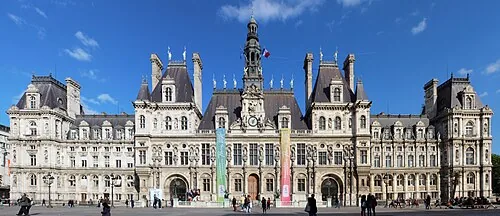
The Hotel de Ville is Paris's city hall, on the north bank in the 4th arrondissement, and it has been the seat of the municipality on this site since 1357. The building you see is a Renaissance-revival reconstruction of 1874 to 1892 by Ballu and Deperthes, raised after the original was burnt out in the last week of the Commune in May 1871. Its facade carries well over a hundred statues of figures from the city's history, and the square in front is used for public events all year.
Open in the planner →Getting there
Hotel de Ville on lines 1 and 11 comes up at the building. Chatelet on lines 1, 4, 7, 11 and 14 is one stop or five minutes on foot, so from central Paris this is effectively a walk. Rambuteau on line 11 and Pont Marie on line 7 are each under ten minutes away, and the Batobus and the river boats stop at the quai just below. The main entrance for exhibitions is on the rue de Rivoli side or at 5 rue Lobau, depending on what is on.
What you see
Most of what there is to see is outside. Stand well back on the place or across rue de Rivoli to take in the frontage: the central clock pavilion, the corner domes, the allegorical groups over the entrance and the ranked statues of Parisians along the two wings, each named on its plinth. The square in front, cleared of traffic, holds the civic programme through the year, including a large temporary installation in winter. When the lower hall is open for an exhibition you enter a long vaulted space used for free shows on Paris history, photography and the city's own collections, which is usually a half hour inside. The staterooms upstairs, with the great ballroom and the painted ceilings, are not generally open to walk-in visitors.
What to pair it with
The Centre Pompidou is eight minutes north, Notre-Dame and the Ile de la Cite are across the Pont d'Arcole, and the Marais begins immediately behind the building.
When to go
Any daylight hour works for the facade; late afternoon puts the sun on the main front. Exhibitions in the lower hall are busiest at weekends and in the hour after lunch. Winter brings the big installation and the associated crowds to the square, and summer brings the free outdoor events, so the place itself is rarely empty.
What is hard about it
You normally cannot go in. Access is limited to whatever temporary exhibition is running in the lower hall, with timed entry or a queue and nothing like a tour of the building; the grand interiors are reserved for official occasions and for the September heritage weekend, when the queue is hours long. Visitors who come expecting a palace to walk through leave having looked at a wall. There is also no vantage point from which the whole facade photographs comfortably, and the square is hard surfaced with almost no shade.
Common questions
Can you go inside the Hotel de Ville?
Only for exhibitions in the lower hall, which are normally free to enter. The ceremonial rooms upstairs are not open to general visitors except on special heritage days.
How long do you need there?
Ten to fifteen minutes for the facade and the square, or about forty-five if there is an exhibition on that interests you.
Why does it look older than it is?
The medieval and sixteenth-century building burnt down during the Commune in 1871, and the replacement was deliberately built in the same Renaissance manner, larger, between 1874 and 1892.
More of the same kind
- Eiffel TowerGustave Eiffel's 330-metre iron tower, the one unmistakable thing on the skyline
- Arc de TriompheNapoleon's arch at the top of the Champs-Élysées, with a roof terrace
- Palais GarnierGarnier's opera house, all marble staircase, gold and Chagall ceiling
- Place de la ConcordeThe largest square in Paris, with an Egyptian obelisk at its centre
Part of these routes
- Le MaraisThe quarter the nineteenth century forgot to rebuild: mansions, squares and two fine museums.
- Paris in five daysA fuller first visit: the island, the Louvre, the Left Bank, Montmartre and Versailles.
- Paris at lengthEverything the other routes cover, spread over unhurried days with nothing rushed.