Palace of Versailles
Louis XIV's palace, the Hall of Mirrors and the gardens behind it
- Area Versailles
- Type Palace
- Time needed 4h
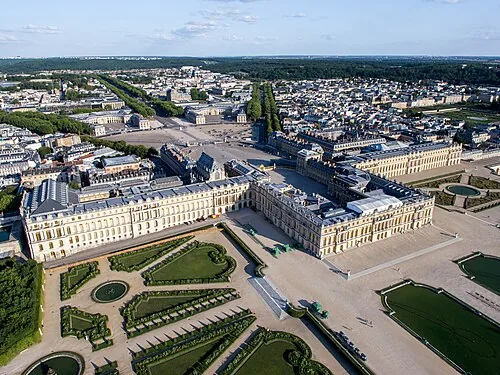
The Château de Versailles was Louis XIV's seat of government from 1682 until 1789, and the estate runs to some 800 hectares of palace, formal gardens, canal and outlying houses. The set pieces are the Hall of Mirrors, the King's and Queen's State Apartments, the Royal Chapel and the gardens by Le Nôtre, with the Grand Trianon, the Petit Trianon and Marie-Antoinette's hamlet a long walk further out. It is about 20 kilometres south-west of central Paris, it needs a full day, and it is the most crowded single destination in the region.
Open in the planner →Getting there
RER C to Versailles Château Rive Gauche is the standard route and the closest station, about a ten minute walk to the gates; allow around 45 minutes from central Paris, and note that RER C branches, so check the train's destination on the platform board. Transilien L from Saint-Lazare to Versailles Rive Droite and Transilien N from Montparnasse to Versailles Chantiers both work and are often less crowded, with walks of fifteen to twenty minutes at the far end. Whichever you choose, you need a ticket valid outside central Paris, not a standard city fare.
What you see
Through the gilded gates and the Cour d'Honneur, the palace route begins with the Royal Chapel, then runs through the Hercules Salon into the State Apartments: a sequence of rooms each named for a planetary deity, with painted ceilings, marble, and the king's bed in the Apollo Salon. The Hall of Mirrors follows, 73 metres of arcaded mirrors facing seventeen windows onto the gardens, with the Peace and War salons at either end. Then come the Queen's Apartments, the Coronation Room with the David canvas, and the long Battles Gallery. Outside, the garden front opens onto Le Nôtre's terraces, the Latona and Apollo fountains and the Grand Canal on one axis — a walk of well over a kilometre to the far end. The Trianon estate is beyond that: the pink marble Grand Trianon, the smaller Petit Trianon, and the Hameau de la Reine, the thatched model farm village Marie-Antoinette had built, with its lake and dairy.
What to pair it with
Nothing else in Paris combines with Versailles in the same day; treat it as its own trip. In the town, the Potager du Roi kitchen garden and the Salle du Jeu de Paume are both a short walk, and the covered Notre-Dame market makes a better lunch than anything on the estate.
When to go
Go early. Be at the gates for opening with a timed ticket already booked and you will get through the State Apartments ahead of the coach parties, which begin arriving mid-morning; by midday the Hall of Mirrors is shoulder to shoulder. Closed one day a week, so check before fixing a date. Tuesdays and weekends are heaviest, and the summer school holidays heaviest of all. The fountains run to a schedule on certain days in the warmer months, with a separate charge and bigger crowds; the gardens look their best then, but a crisp weekday in spring or autumn is a far more comfortable visit. In winter the fountains are off and some outer buildings close, but the palace is quiet.
What is hard about it
Versailles punishes anyone who turns up unprepared. Timed booking is normally needed, security screening at the entrance queues even with a slot, and the one-way route through the State Apartments becomes a slow shuffle you cannot leave. Expect a lot of walking: the gardens are vast and the Trianon estate is a separate walk of roughly half an hour each way from the palace, or a paid shuttle train, hire bike or electric cart. The gardens and Trianon are also ticketed separately from the palace on fountain days, which catches people out. Food and drink on the estate are expensive and queued; bring water. There are stairs on parts of the palace route, though accessible routes exist and should be arranged in advance. Many visitors leave having seen the Hall of Mirrors over other people's heads and nothing of the Trianon at all.
Common questions
How long do you need at Versailles?
Four hours is the realistic minimum for the palace and part of the gardens. A full day of around seven hours is what the Trianon estate and the hamlet actually require.
What is the best way to get there from Paris?
RER C to Versailles Château Rive Gauche is the closest station and the simplest route, about 45 minutes from central Paris. Transilien from Saint-Lazare or Montparnasse is often less crowded but leaves a longer walk.
Can I just see the gardens?
Yes, the gardens can be visited without entering the palace, and on most days they cost nothing to walk in. On fountain show days a separate ticket applies.
More of the same kind
- Palace of FontainebleauEight centuries of French monarchs in one much-altered palace
- Château de ChantillyA moated château with the finest painting collection outside the Louvre