Palace of Fontainebleau
Eight centuries of French monarchs in one much-altered palace
- Area Fontainebleau
- Type Palace
- Time needed 3h
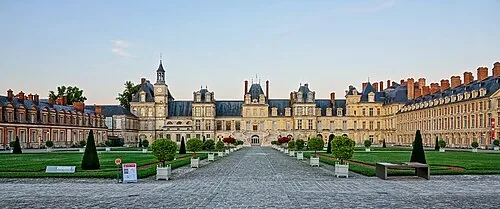
Fontainebleau is a royal residence about 55km south-east of Paris that was lived in, altered and added to by French rulers from the twelfth century to the Second Empire. Unlike Versailles it was never built to one plan, so the result is a sprawl of courtyards and wings in several styles. Napoleon abdicated here in 1814, and the palace still keeps his apartments. Allow around three hours inside, plus the travel.
Open in the planner →Getting there
Take a Transilien line R train from Gare de Lyon to Fontainebleau-Avon; the direct trains take roughly 40 minutes, and Gare de Lyon is about 10 minutes from Châtelet on Métro 1 or RER A. From the station the palace is not walkable in comfort, so use the local bus from the station forecourt towards the château and Fontainebleau town centre, which takes about 15 minutes and drops you near the gates. Reckon on an hour and a half door to door from central Paris each way. Check the return timetable before you go in, because evening trains thin out.
What you see
You enter across the Cour du Cheval Blanc, the broad forecourt with the horseshoe staircase where Napoleon said goodbye to his guard. Inside, the Renaissance core comes first: the long Galerie François I, panelled and frescoed along its whole length, and the Salle de Bal with its painted ceiling and gallery of windows looking two ways. Then the royal and imperial apartments run on through bedchambers and council rooms, ending in Napoleon's small suite with the abdication table. The chapel of the Trinity sits above, and outside there are the carp pond, the formal parterre and the long canal, all free to walk.
What to pair it with
Nothing in Paris pairs with it, because the journey eats the day. Pair it instead with the town of Fontainebleau itself for lunch, or with a walk in the Forest of Fontainebleau, whose sandstone boulders start a short bus ride away. If you want a second palace, do Versailles on a separate day rather than the same one.
When to go
Go on a weekday morning and you may have the Galerie François I nearly to yourself; Fontainebleau takes a fraction of Versailles's crowds. Weekends and French school holidays are busier but still manageable. Spring and autumn are best, because the gardens and the forest are the other half of the visit. The palace closes one day a week, so check before you go.
What is hard about it
The travel is the real cost: a train plus a bus each way, and a missed connection can add an hour. The interior is a long enfilade of rooms with no lift to the upper floors and a good deal of walking on hard parquet. Some wings and the Napoleon museum rotate in and out of access, so you cannot assume everything will be open. Labelling is thinner than at the big Paris museums, and visitors who come expecting Versailles sometimes find the patchwork of styles confusing rather than grand.
Common questions
How long do you need at Fontainebleau?
About three hours for the apartments and galleries, and another hour if you walk the gardens and the canal. With travel it is a full day out of Paris.
Can you do Fontainebleau and Versailles in one day?
In theory yes, in practice no. They are on opposite sides of Paris and each needs half a day, so you would see neither properly.
Is the bus from the station necessary?
Effectively yes. The walk from Fontainebleau-Avon to the palace is around 40 minutes along roads, and the bus is timed to meet the trains.
More of the same kind
- Palace of VersaillesLouis XIV's palace, the Hall of Mirrors and the gardens behind it
- Château de ChantillyA moated château with the finest painting collection outside the Louvre