Château de Chantilly
A moated château with the finest painting collection outside the Louvre
- Area Chantilly
- Type Palace
- Time needed 3h
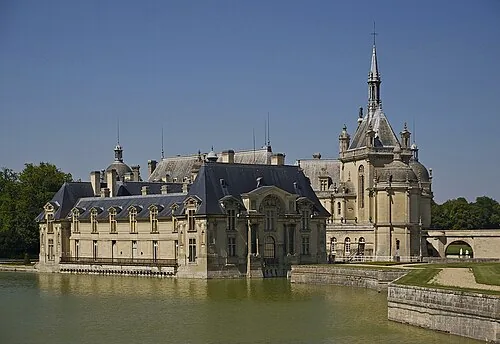
The Chateau de Chantilly sits on water about 40 km north of Paris in the Oise, rebuilt in the 1870s and 1880s for Henri d'Orleans, Duc d'Aumale, on the foundations of the Conde family's castle. He left it to the Institut de France with his collection and a rule that no painting may be moved or lent, so the Musee Conde hangs exactly as he arranged it, in the order he chose. It is the largest collection of old master paintings in France after the Louvre, and the Great Stables beside it were built in 1719 for 240 horses.
Open in the planner →Getting there
Trains for Chantilly-Gouvieux leave from Gare du Nord, on the main-line side rather than the RER side, and take about twenty-five minutes on a fast service; RER D also serves the station more slowly. From Chatelet allow about ten minutes on RER B or line 4 to Gare du Nord, then the train. Check which platform hall your train leaves from, as it is not the suburban one. From Chantilly-Gouvieux station the chateau is a signposted walk of twenty to twenty-five minutes through the woods and along the racecourse, or a short local bus or taxi ride; the walk is pleasant in dry weather and dull in wet.
What you see
The approach across the moat past the equestrian statue of the Connetable is the view the place is known for. Inside, the Grands Appartements of the Princes de Conde come first, eighteenth-century panelled rooms with the Singerie, a small cabinet painted with monkeys acting out human scenes. The Musee Conde follows, and its hanging is the point: paintings stacked frame to frame in the Galerie de Peinture by subject rather than by school, and in the Santuario a tight room holding Raphael's small panels and Filippino Lippi's Esther. The library, the Cabinet des Livres, holds the manuscripts, among them the Tres Riches Heures du Duc de Berry, of which a facsimile is normally shown rather than the original. Outside, Le Notre's formal canals and parterres run north from the terrace, with an English garden and the Hameau to one side. The Great Stables, five minutes' walk away, are a vast vaulted hall under a dome and run demonstrations in the ring; they are a separate building with their own timetable.
What to pair it with
This is a day out of Paris on its own. Chantilly town and the racecourse are between the station and the chateau, and the forest paths north of the park make an easy extension. Senlis, a small medieval town with a Gothic cathedral, is twenty minutes away by bus if you want a second stop.
When to go
Go early and on a weekday: the galleries are quiet before midday and the gardens are at their best in morning light. The park is strongest from late spring to October; in winter the fountains are off, parts of the garden shut and the walk from the station is bleak. The equestrian demonstrations in the Great Stables run to a fixed daily schedule, so look it up before you set out and build the day around it. Weekends and French school holidays are busy with families.
What is hard about it
This is a half day minimum and realistically a full one: the train, the walk at the far end and three hours on site add up, and rushing it wastes the painting collection. The chateau is closed one day a week in most seasons and the stables keep different hours from the house, so an unchecked trip can arrive to find half of it shut. The ticket is not cheap and there are separate options covering house, park and stables in different combinations; work out which you want before you buy. The Tres Riches Heures is almost never on display in the original. The galleries are dimly lit by conservation standards and the hanging, deliberately crowded and unlabelled by modern convention, frustrates people used to a chronological museum.
Common questions
How long do you need at Chantilly?
Three hours on site for the house, the Musee Conde and a look at the gardens, plus about two hours of travel and walking in total. Add an hour for the Great Stables.
How do you get there from Paris?
Main-line trains from Gare du Nord to Chantilly-Gouvieux take about twenty-five minutes, then a twenty-minute walk or a short bus ride to the chateau.
Can you see the Tres Riches Heures?
Normally only as a facsimile. The original manuscript is kept from light and is shown very rarely.
More of the same kind
- Palace of VersaillesLouis XIV's palace, the Hall of Mirrors and the gardens behind it
- Palace of FontainebleauEight centuries of French monarchs in one much-altered palace