Parc de Saint-Cloud
Le Nôtre's terraced park above the Seine, the palace long gone
- Area Saint-Cloud
- Type Park
- Time needed 2h
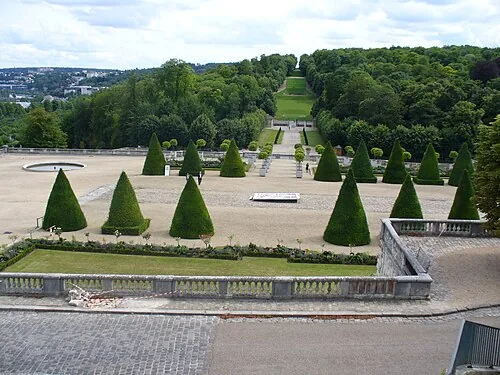
The Domaine national de Saint-Cloud is a 460-hectare park on the hillside above the Seine just west of Paris, laid out by Andre Le Notre from the 1660s for Philippe d'Orleans. The palace it was built around burnt in 1870 during the Franco-Prussian war and was demolished in 1891, so the terraces, avenues and waterworks survive without the house they framed. It is a large, open, largely free park with a long view back over the city.
Open in the planner →Getting there
Boulogne-Pont de Saint-Cloud at the western end of line 10 is about ten minutes' walk across the Seine bridge to the lower gate. Tram T2 stops at Parc de Saint-Cloud, close to the same entrance, and Saint-Cloud station on Transilien line L from Gare Saint-Lazare puts you near the upper side of the park. From Chatelet take line 1 west and change for line 10, about thirty-five to forty minutes in all. Note that the park climbs steeply from the river gate; entering from the Saint-Cloud or Garches side starts you at the top.
What you see
From the bottom gate the Grande Cascade rises ahead of you, a long baroque stair of basins and masonry by Lepautre and Hardouin-Mansart, dry most of the time and run only on scheduled days. Above it the Allee de Marnes and the Allee Royale open out, with the Grand Jet fountain and the Bassin du Fer a Cheval on the main axis. The Rond-Point de la Balustrade, where the palace stood, is marked by yew outlines and an orientation table, and gives the panorama over the Bois de Boulogne to the Eiffel Tower and La Defense. The Jardin du Trocadero to the north is a nineteenth-century landscaped garden with a pond and old trees, and the Musee historique in a surviving service building explains the lost palace with models and prints. The far western reaches are woodland and quiet, with the Pavillon de Breteuil and the national metrology institute behind their own walls.
What to pair it with
The Bois de Boulogne and the Jardin d'Acclimatation are across the river, and the Fondation Louis Vuitton is reachable from the same side. The Sevres ceramics museum is two tram stops south.
When to go
Spring and autumn are the park at its best, with the avenues in leaf or colour and the view clear. Weekend afternoons bring families to the lower lawns; weekday mornings are almost empty. The fountain displays, when the cascade actually runs, are a handful of scheduled days a year and are the only time the waterworks make sense, so check before you go if that is the draw. Winter gives the sharpest view over Paris but a bare, windy park.
What is hard about it
There is no palace. People arrive expecting a Versailles and find lawns, gravel and an empty terrace, which is the single most common disappointment here. The ground rises steeply from the river entrance and the distances between features are long, so this is a two-hour walk rather than a stroll, with limited shade on the main avenues. The cascade is dry on ordinary days. The small museum keeps short and seasonal hours, cars pay to enter, and refreshment is limited to a kiosk or two, so bring water.
Common questions
How long do you need at Parc de Saint-Cloud?
About two hours to walk the main axis, the terrace viewpoint and the cascade. Longer if you go into the western woods.
Is there a palace to visit?
No. The chateau burnt in 1870 and was pulled down in 1891; its footprint is marked on the terrace and a small museum covers what was lost.
Is it free to enter?
Entry on foot is free. Bringing a car in is charged, and the museum and any fountain display have their own arrangements.
More of the same kind
- Jardin du LuxembourgFormal gardens round the Senate, with green chairs and a toy-boat pond
- Tuileries GardenThe formal garden between the Louvre and the Concorde
- Parc de la VilletteThe largest park in Paris, scattered with bright red follies
- Bois de BoulogneThe city's western wood, with lakes, gardens and racecourses